



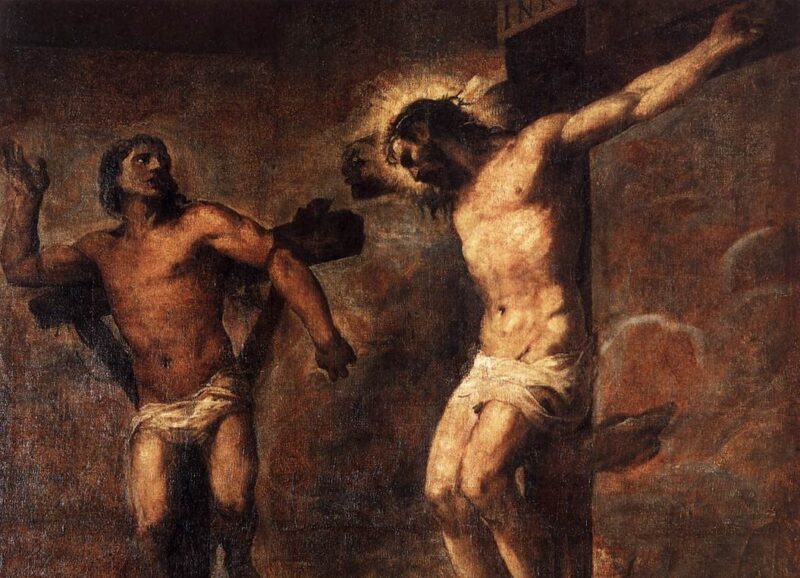
Three prisoners, crucified and therefore with no hope whatsoever of managing to escape. The crowd cries out and challenges without any faith what it knew could not happen unless by some miracle. The scene revolves around the one crucified in the middle. All attention is fixed on him. One of the other criminals joins in with the chorus of the crowd. But the contempt in his voice scarcely bears witness to any belief that the one beside him could really save him. He asks for salvation, yet he already knows it is in vain: he had lived out his days in prison without freedom until he is executed, and he remained a slave upon the cross, without hope of salvation, neither at that moment nor afterwards …
And the crowd was no less enslaved by its lack of faith, by pride and arrogance, enslaved by military violence—both those who wielded it and those who were its victims—and equally enslaved by the craving for power, to the point that they no longer reasoned at all. It was a freedom in a cage, for they were dominated by a foreign and pagan political power.
Yet, there was someone who, in that moment of the total collapse of everything—of humanity’s greatest and basest rebellion against God—the third man crucified breaks this circle of mediocrity, sarcasm, and lack of faith: “Do you not fear God?” This man, who had probably lost all sense of good and evil, without scruples and did whatever came to hand, suddenly has his eyes opened. Just like in Plato’s man in the allegory of the cave man who came out into the light of the sun and arrived at the knowledge of the real reality, so too in that darkness of deceit, bitterness, and arrogance, he recognises that the truth was neither in what had guided his life until that moment nor in the conviction of the crowd and its leaders, who believed they were doing right by getting rid of Jesus because he was making them uncomfortable.
This man, who probably hardly feared anyone or anything, has his eyes opened at that moment and recognises the truth that alone mattered: that the man crucified with him was not only innocent, but that he was there precisely because he had taken upon himself the guilt of humanity so as to reopen the gates of the Kingdom of God for all. And this insight gave him the greatest freedom a human being can ever have: when he chooses no longer to remain a slave—neither to violence and deceit, nor to political powers, nor to his own vices—and opens himself to God’s love, which dismantles us yet fills our hearts completely. And it is this hope alone that can grant the freedom to be embraced by God, because we know that this embrace remains even after what appears to be the final word of death; for we know that even when we feel we are falling into the void, or into the abyss of hell’s darkness and despair, in the end there will be an embrace full of compassion and mercy that receives us, and this paradise may begin now, here, even when everything around us seems dark and hardly makes sense.
This experience is the purpose of the Jubilee: experiencing freedom of heart even when life crucifies us or chokes our freedom; the freedom that comes when we allow our heart to be freed from all the bonds that hold it back from rising upwards. If this Jubilee has led us to experience this, then this year will indeed have been a holy and special one for us, for it will not have left us unchanged, but brought about a radical change that united us more fully with the King as labourers in his Kingdom and as free human beings, crucified with him for the redemption of humanity.