



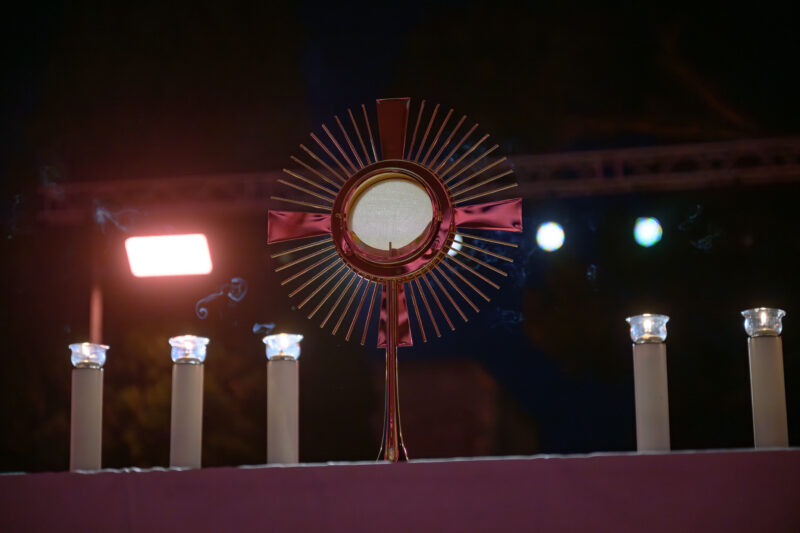
The silence of God in the Sacrament of the Eucharist amazes us because it does not seek to attract us to itself with sounds of trumpets. And so, the silence of God in the Sacrament of the Eucharist can make us uncomfortable in a world where those who shout the loudest and make the most noise are often considered the most powerful.
Nevertheless, it’s as if, in this silence, God offers us a seat in His living room—in His house in our midst, which is also our home—so that we may speak freely and pour out our weary souls. It is a silence that, at the same time, does not force us to speak. If we wish, we may say nothing at all and simply savour His gentle presence, allowing Him to show us that He delights in having us beside Him, even when our clothes are covered with the dust of life and our bodies stained by sin. His space is open to everyone, but it is also an invitation for everyone to become like Him. He loves us and embraces us as we are, yet, because He truly loves us, He desires that we too may be able to offer Him a pure sacrifice, springing from a pure conscience.
The rebuke contained in His silence is not a whip, but rather an invitation of love, like the one the Apostle Paul addresses to the Christians of Rome: “I urge you, brothers and sisters, by the mercy of God, to offer your bodies as a living sacrifice, holy and pleasing to God” (Rom 12:1). In these words, Saint Peter Chrysologus—bishop and doctor of the Church who lived between the fourth and fifth centuries—imagines the Lord Himself speaking to us; indeed, “pleading” with us:
Listen to the Lord’s appeal: In me, I want you to see your own body, your members, your heart, your bones, your blood. You may fear what is divine, but why not love what is human? You may run away from me as the Lord, but why not run to me as your father? Perhaps you are filled with shame for causing my bitter passion. Do not be afraid. This cross inflicts a mortal injury, not on me, but on death. These nails no longer pain me, but only deepen your love for me. I do not cry out because of these wounds, but through them I draw you into my heart. My body was stretched on the cross as a symbol, not of how much I suffered, but of my all-embracing love. I count it no less to shed my blood: it is the price I have paid for your ransom. Come, then, return to me and learn to know me as your father, who repays good for evil, love for injury, and boundless charity for piercing wounds.
Saint Peter Chrysologus, Sermo 108, PL 52.499–500
What, then, will your response be to all these words of love which the Lord Jesus surely speaks in the silence our hearts whenever we stand before Him? Do not flee from silence; return to it. Adore in silence, without words, recognising your own nothingness, but also recognising the One who made Himself nothing for your sake. Acknowledge this, and do not be afraid. Then respond. Respond with silent praise, with thanksgiving, with tears of joy. Respond by allowing yourself to taste this sweetness of heaven and the gentle fragrance of Him who is the fairest of the sons of men (cf. Psalm 45:2).