


Allowing our spirit to be lifted beyond
The Third Reflection on the Mosaic in the Church of “Tal-Erwieħ,” Ħal Tarxien
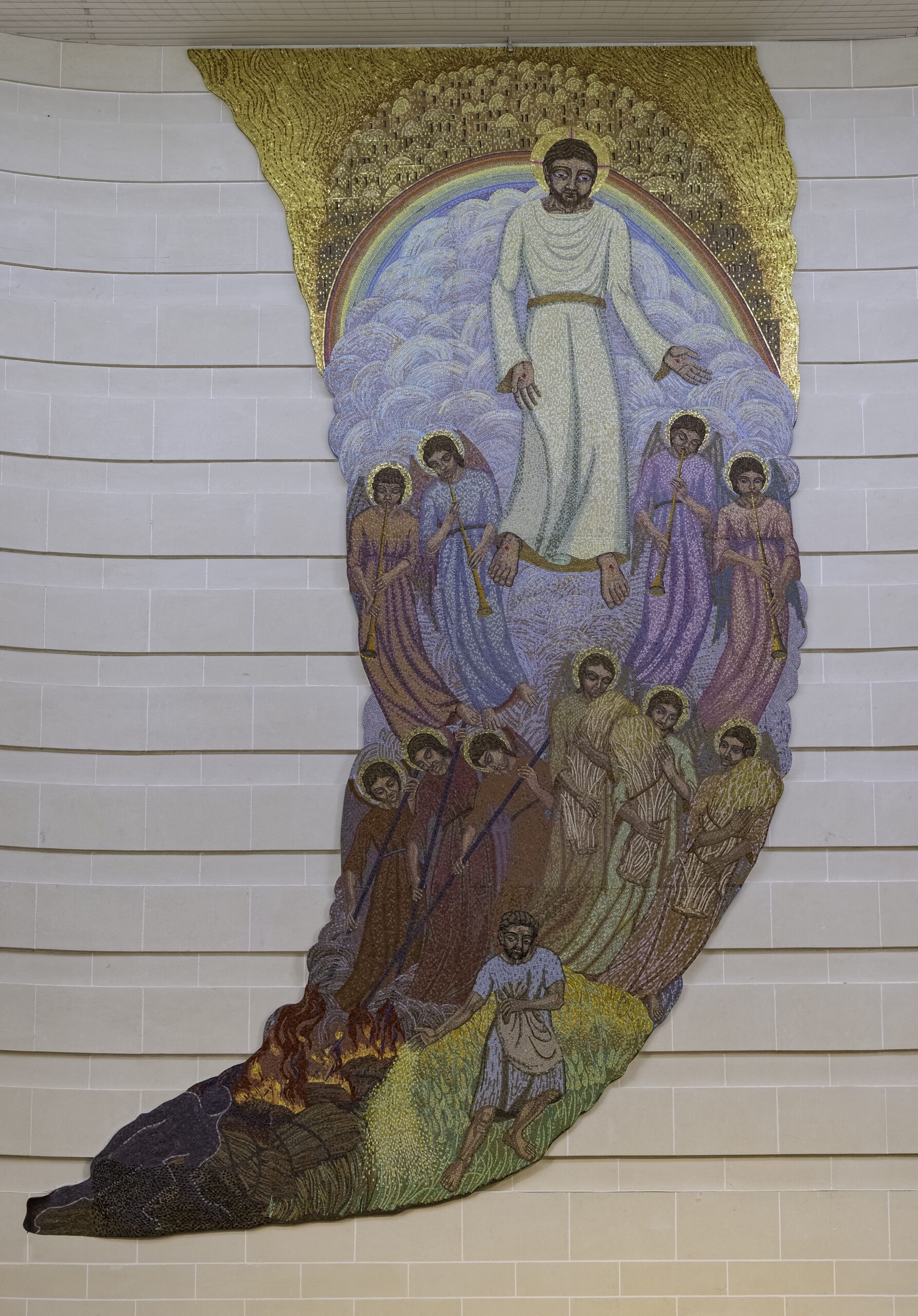
The dominant figure in the mosaic above the altar of the Church of Tal-Erwieħ is undoubtedly that of Jesus, “the first-born of the dead” and “the first fruits of those who have fallen asleep” (Rev 1:5; 1 Cor 15:20). Jesus, who is at once both the one who sows in the present—the two similar figures form a clear vertical line between them—and the judge, whose pierced hands are opened wide to receive the good fruit.
In his nocturnal meeting with Nicodemus, Jesus himself declared: “For God sent the Son into the world, not to condemn the world, but that the world might be saved through him” (Jn 3:17). These are also the words which the Church sings in the Pange Lingua on Holy Thursday night, as the Eucharist is carried to the Altar of Repose, and again on the feast of Corpus Christi after Eastertide:
Of a pure and spotless Virgin
St Thomas Aquinas
born for us on earth below,
He, as Man, with man conversing,
stayed, the seeds of truth to sow;
then He closed in solemn order
wondrously His life of woe.
Yet in that same dialogue with Nicodemus, beneath the cover of night, Jesus also affirms that “he who believes in him is not condemned; he who does not believe is condemned already, because he has not believed in the name of the only Son of God” (Jn 3:18).
Meanwhile, Jesus the sower continues tirelessly to sow, for God never loses hope in humanity. He keeps scattering goodness and pouring out his grace even where there seems little chance of fruit, because truly “he who keeps Israel will neither slumber nor sleep” (Ps 121:4). This divine faithfulness is represented in the mosaic by the rainbow found just above Christ’s head—like the great, high mountain to which John was carried in the Spirit to see “the holy city Jerusalem coming down out of heaven from God” (Rev 21:10). More than once, this symbol has been misunderstood or used as an instrument of division and polarisation by opposing camps. Yet it is good to return to its biblical meaning: literally, the bow of God. In the story of Noah and the flood, God sets the rainbow in the clouds as a reminder of his covenant with humanity that never again shall such destruction come upon the earth (Gen 9:8-17). Even more, not only does God refrain from destroying humankind, but fulfils this covenant by becoming himself part of it, and through the wood of the cross saves us from the flood of sin and death.
“And I, when I am lifted up from the earth, will draw all men to myself.”
John 12:32
In this season of Advent, as we prepare ourselves for our encounter with the Lord face to face when our hour comes, and as we prepare to celebrate the moment when God became one of us for our salvation, may we let our spirit be lifted upwards, beyond, towards the One who is above the rainbow; and, whoever we are, let us once more place our hope in him alone, and in nothing else.