



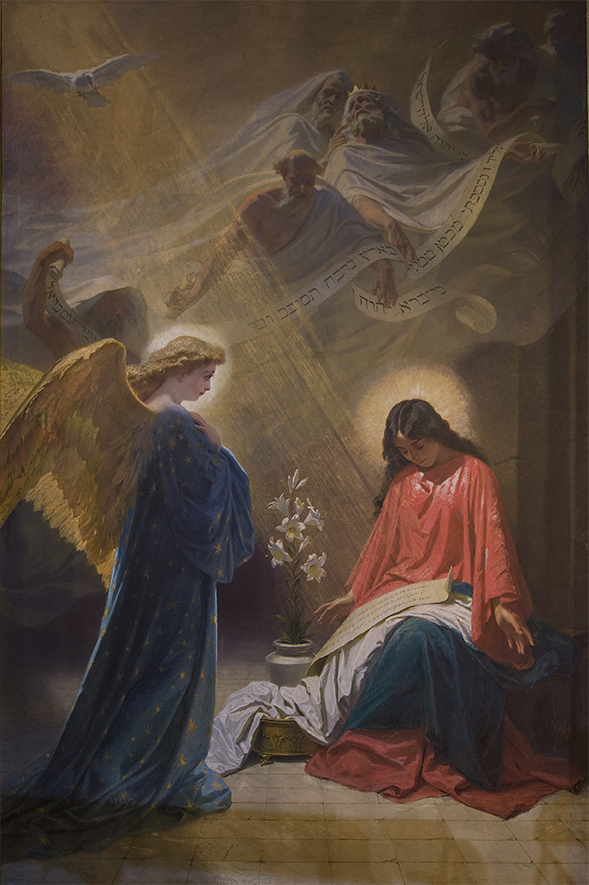
And the Word Became Flesh
Fourth Reflection on the Panel of the Annunciation in St Paul’s Cathedral, Mdina
And the Word became flesh and dwelt among us, full of grace and truth; we have beheld his glory, glory as of the only Son from the Father.
John 1:14
In this panel we find several symbols which in various ways connect with what we read in the Prologue of John’s Gospel. Firstly, there is a diagonal beam of light beginning from the upper left corner and descending directly upon Mary’s womb—light which seems to emerge from somewhere beyond the panel (from the hidden throne of God) and reaches the small sanctuary of flesh where he descended in order to save this very flesh of ours: “the true light that enlightens every man was coming into the world” (Jn 1:9). Within this ray of light is a white dove, the image of the Holy Spirit, literally descending upon Mary, as shown by its downward gaze and drawn-back wings (cf. Lk 1:35).
Another extraordinary element in this panel is the scroll in Mary’s lap. This scroll complements the scrolls in the hands of the Old Testament figures, as we have already explained. But this scroll of Mary is not only prophecy; it is the end of prophecy, its fulfilment: it is the image of the Word of God becoming flesh in her womb at that very moment (Jn 1:14a).
The Word was made Flesh in order that the Flesh might begin to be what the Word is.
St Hilary of Poitiers, De Synodis 48 (PL 10.546)
As we are celebrating this great mystery, pause over these words and, before the scene Bruschi paints for us, recognise how literal and concrete the Incarnation truly is. How is this truth shaping the concreteness of your life? Does it change how you look upon the reality of your own flesh and that of your brothers and sisters? Do you allow God to continue writing his good news for the world through your humanity?