



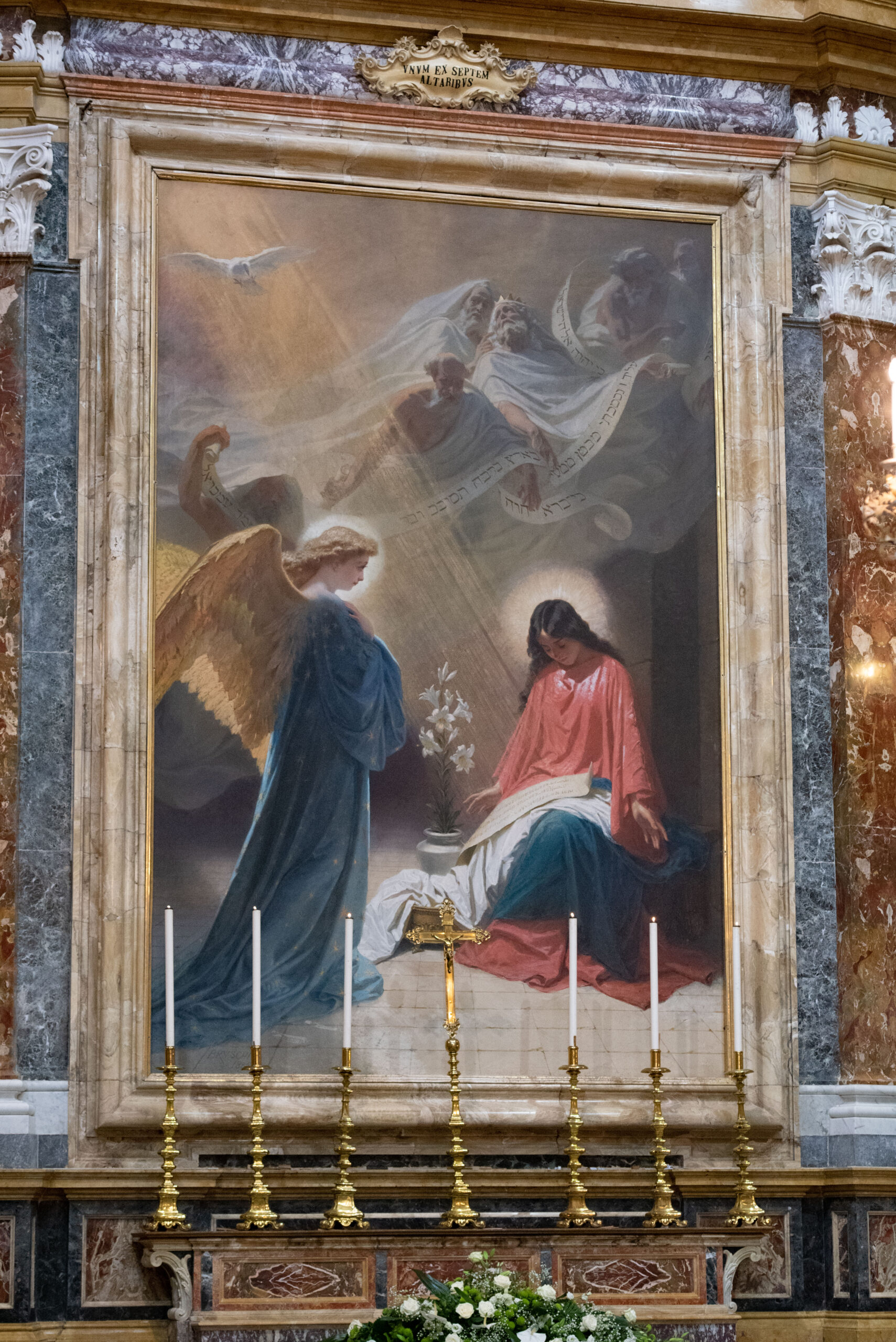
God who waits for the answer
First Reflection on the painting of the Annunciation in St Paul’s Cathedral, Mdina
You have heard, O Virgin, that you will conceive and bear a son; you have heard that it will not be by man but by the Holy Spirit. The angel awaits an answer; it is time for him to return to God who sent him. We too are waiting, O Lady, for your word of compassion; the sentence of condemnation weighs heavily upon us.
Saint Bernard, Homilies on the Praises of the Virgin Mary, 4.8
As an icon for our contemplation in this holy season of Advent, we shall place before us the painting of the Angel’s Annunciation to Mary found on the altar of the left-hand chapel in Mdina Cathedral. The representation of this scene by the Perugian artist Domenico Bruschi (1840–1910) was rather innovative for Malta. We may say that the scene is divided in two: heaven and earth, with the upper part being somewhat animated in contrast to the stillness of the lower part. The angel, clothed in a robe of stars, firmly resting on the ground and at the same time with his head turned towards the vision of heaven, serves as a bridge between the two, his gaze fixed upon Mary as he waits for her response.
And it is precisely in this waiting that we find the mystery of the great respect God has for our freedom, to the point that he is willing to wait: he is not prepared to trample upon us in order that his will be fulfilled, even though the human response might possibly be negative; he is not prepared to take back the gift of freedom, even if we ourselves at times prefer to reject it. Yet it is this very freedom of ours that opens us to what goes beyond the world we see. It is freedom that opens us to the mystery of God.
In the fast passed world we are living in, we are often unwilling to wait for another’s response. We find it easier to take matters into our own hands. While passivity is not a Christian response, this season of Advent reminds me that with humility I must stop and wait for the other, that I must give space to the freedom of the other, and that I must not stifle in the other the work of God which unfolds slowly.