



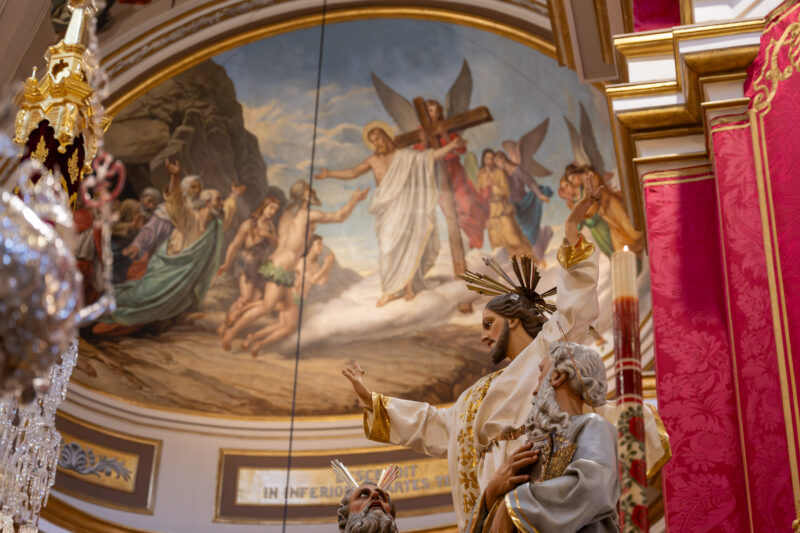
Besides the account found in the Synoptic Gospels—that is, those according to Matthew, Mark, and Luke—the Liturgy of the Feast of the Transfiguration also draws our attention to another passage in the New Testament in which this event is recounted in the first-person plural by someone who was present and witnessed this marvellous transformation. In the Second Letter of Saint Peter—probably addressed, like the First Letter, to the churches of Asia Minor in what is now Turkey (see 2 Pet. 3:1)—the author writes:
For we did not follow cleverly devised myths when we made known to you the power and coming of our Lord Jesus Christ, but we were eyewitnesses of his majesty. For when he received honour and glory from God the Father and the voice was borne to him by the Majestic Glory, ‘This is my beloved Son, with whom I am well pleased,’ we heard this voice borne from heaven, for we were with him on the holy mountain. And we have the prophetic word made more sure. You will do well to pay attention to this as to a lamp shining in a dark place, until the day dawns and the morning star rises in your hearts.
2 Peter 1:16–19
Here Peter shows us clearly that he no longer remained attached to the dream and the genuine desire that that moment should last for ever, when he said: “Lord, it is well that we are here; if you wish, I will make three booths here, one for you and one for Moses and one for Elijah” (Mt 17:4). By the time he wrote this letter—or someone else wrote it in his name—Peter had travelled a long road from the holy mountain of the Transfiguration. He had learned to follow the Lord, to return to him after the Resurrection even though he had denied him when that glory gave way to the tragedy of the Cross. He journeyed tirelessly until he reached Rome, where he too allowed the paradox of Calvary to be fulfilled in his own life.
In the High Priestly Prayer during the Last Supper, Jesus, lifting up his eyes, declares: “Father, the hour has come; glorify thy Son that the Son may glorify thee” (Jn 17:1). Indeed, the radiance of the Transfiguration was but a foretaste of the glory that would be revealed in its fullness when he hung upon the wood between heaven and earth. There, indeed, we beheld his glory. There we witnessed the greatest love. There, in that cry which resounded to the four winds of the earth more powerfully than the crash of thunder, we heard the Word par excellence: the breath of agony with which he uttered the supreme declaration of his fidelity to the plan of salvation hidden within the very heart of the Trinity. It is no wonder that the Evangelist John presents to us this most powerful declaration of the Word made flesh:
“When you have lifted up the Son of man, then you will know that I am he, and that I do nothing on my own authority but speak thus as the Father taught me. And he who sent me is with me; he has not left me alone, for I always do what is pleasing to him.”
John 8:28–29
May we truly welcome the command of the voice that Peter and his companions heard borne from the Majestic Glory: “This is my beloved Son, with whom I am well pleased; listen to him” (Mt 17:5).