



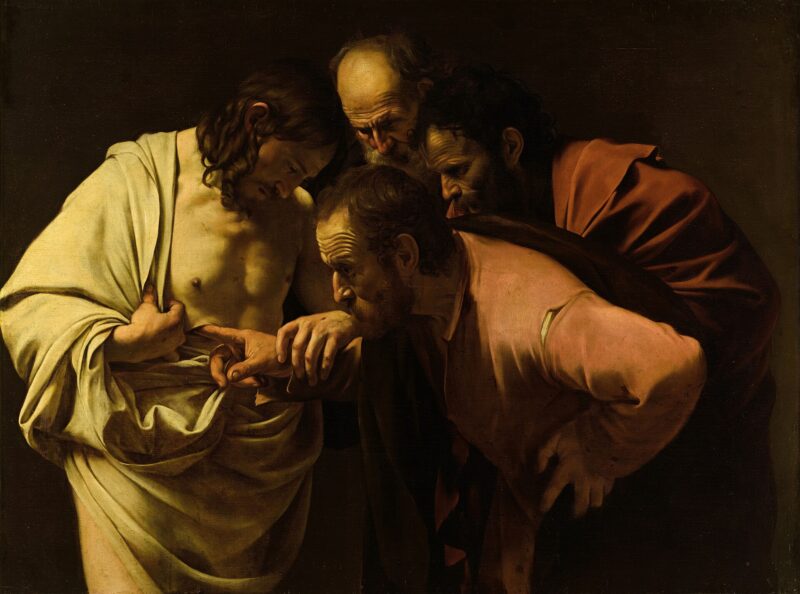
On 3 July, the Church celebrates the feast of the Apostle Thomas, “one of the twelve, called the Twin” (Jn 20:24). Thomas and the Twin may seem to be nothing more than a name and a nickname that help identify a person. Yet nothing in the Word of God is without a deeper meaning. Both his name and his title—in Greek Δίδυμος (Didymus)—mean exactly the same thing: both mean the twin.
Who is a twin? A twin is someone who, from the womb, has never been alone. Twins, especially identical twins, are inseparable. Wherever they go and whatever they do, they always have their brother or sister. Throughout the unfolding of John’s Gospel, we can see how Thomas as if lives out his relationship with Jesus precisely within this dynamic. When Lazarus dies and Jesus decides, despite the danger, to go to Bethany to Martha and Mary, Thomas tells the others: “Let us also go, that we may die with him” (Jn 11:16). He was prepared to die with Jesus because he could not bear to be without him. Then, at the Last Supper, when Jesus tells the disciples that he is returning to the Father, Thomas cannot imagine remaining without the one who had become the other half of his life. He therefore asks him: “Lord, we do not know where you are going; how can we know the way?” (Jn 14:5).
After the Passion, however, this twin is left alone and withdraws into isolation. His life seems to have come to an end, so much so that he no longer remains hidden for fear of the Jews. They could kill him if they wished. After all, when the moment of trial came, he had failed spectacularly and fled from the one who had become so dear to him. And what Thomas asks of the disciples, when he finds them gathered where he had left them, is not the fruit of scepticism. He does not reject the possibility of the resurrection, and as a Jew he believed in the resurrection of the dead at the end of time. Thomas insists on seeing the wounds before he believes because of a deeper faith—one born of something that, consciously or not, he had already understood: if he was to be certain that the one standing before him was truly Jesus, he had to see and touch his wounds. The others spoke to him of glory; Thomas wanted to see the wounds.
Through the dignity bestowed upon us in Baptism, we too, like Thomas, have become in a certain sense twins of the Lord: his brothers and sisters in our humanity, and adopted children of the Father in him and with him. To be truly Christian means, therefore, allowing nothing to separate us from him. This is the essence of the Christian mission: to become ever more like Christ, so that, when the world looks upon a Christian, it may clearly recognise the Master.
Meanwhile, there are the eight days: the seven days that begin with the new creation brought about through the Resurrection of Jesus, and then once again the first day of the week, when from the very beginning the Christian community gathered to celebrate his death and Resurrection in the Eucharist. This is also the rhythm that marks our lives—not so much socially as spiritually. Between one Sunday and the next, we are given the opportunity to become ever more these twin brothers and sisters of Christ, who in the Eucharist are made one with him, so that, at the end of Mass, we are sent forth to make him present through the transparency of our lives.