



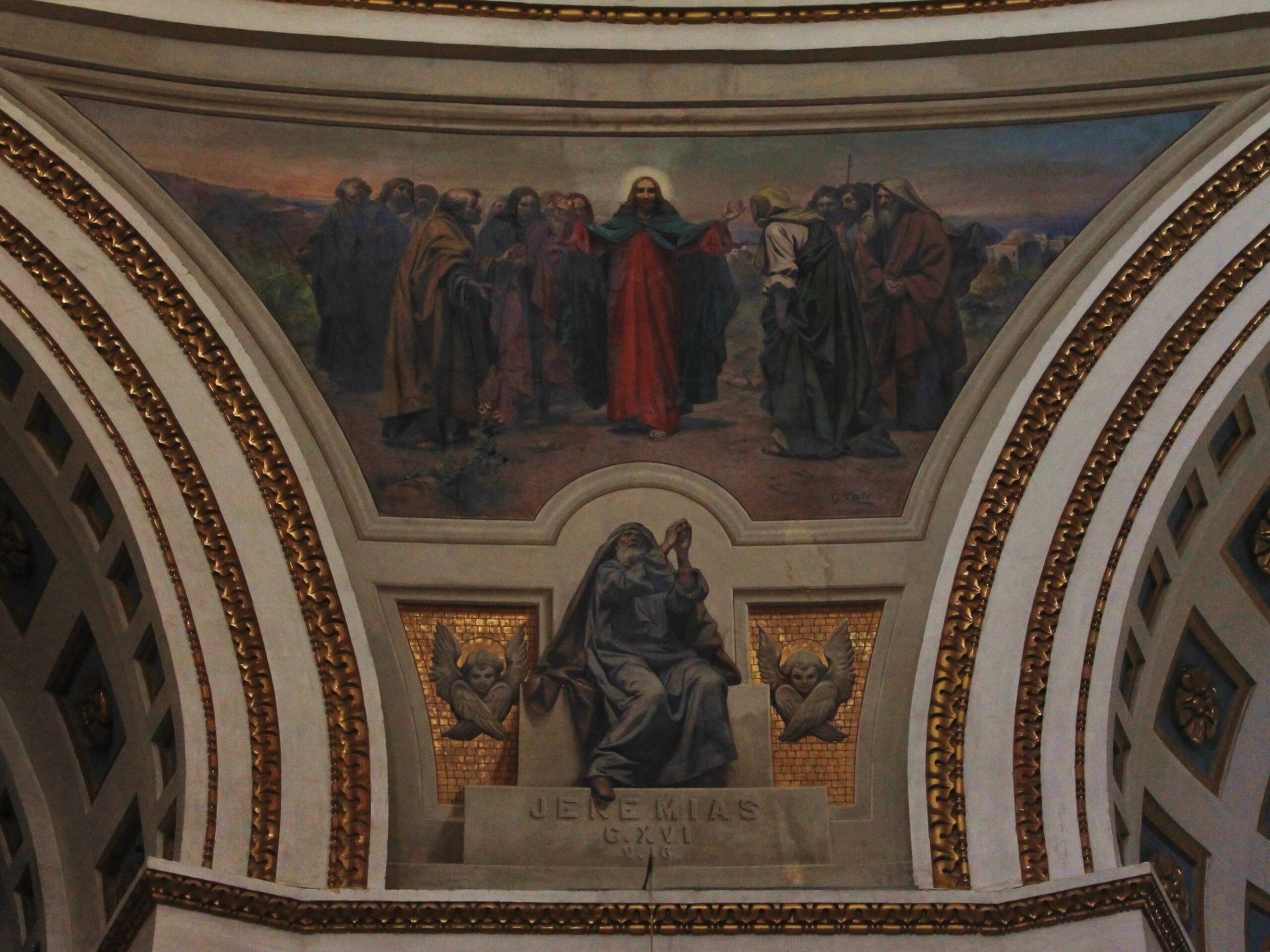
He went up on the mountain and called to him those whom he desired
First Reflection on the Painting of Jesus with the Apostles
How beautiful upon the mountains
are the feet of him who brings good tidings,
who publishes peace,
who brings good tidings of good,
who publishes salvation,
who says to Zion, “Your God reigns.”(Isaiah 52:7)
Over the coming weeks, we shall place before us for contemplation one of the eight lunettes found in the Sanctuary Basilica of the Assumption of Our Lady in Mosta, namely the one depicting Jesus surrounded by the Apostles. The scene unfolds on elevated ground overlooking the town. Throughout salvation history, the high places—hills and mountains—possess not only geographical significance but also profound theological meaning. In the accounts of Moses, the mountain is the place of encounter with God, where God gives his Law to his people.
Both Mark and Luke situate the calling of the Twelve within this same context. Mark tells us that Jesus “went up on the mountain and called to him those whom he desired; and they came to him. And he appointed twelve” (Mark 3:13–14a, RSV), while Luke specifies that this choice came after Jesus had spent the entire night in prayer on the mountain (Luke 6:12–13). The calling of the Twelve, therefore, is the fruit of discernment—a night spent in prayer—and takes place in the setting of revelation and encounter with God.
Every Christian vocation brings us face to face with God and reveals to us who he is. At the same time, it brings us face to face with ourselves in our weakness, revealing who we truly are at the deepest level of our being and who we are called to become. In coming to know God, we also come to know ourselves, discovering the person we were created to be.
As you reflect upon the Lord’s choice to call you to be his disciple and witness, allow him to look upon you and reveal who you truly are in the fullness of truth, and towards what fullness you are called to strive, so that his image within you may shine forth in all its beauty.