



Roses without Thorns
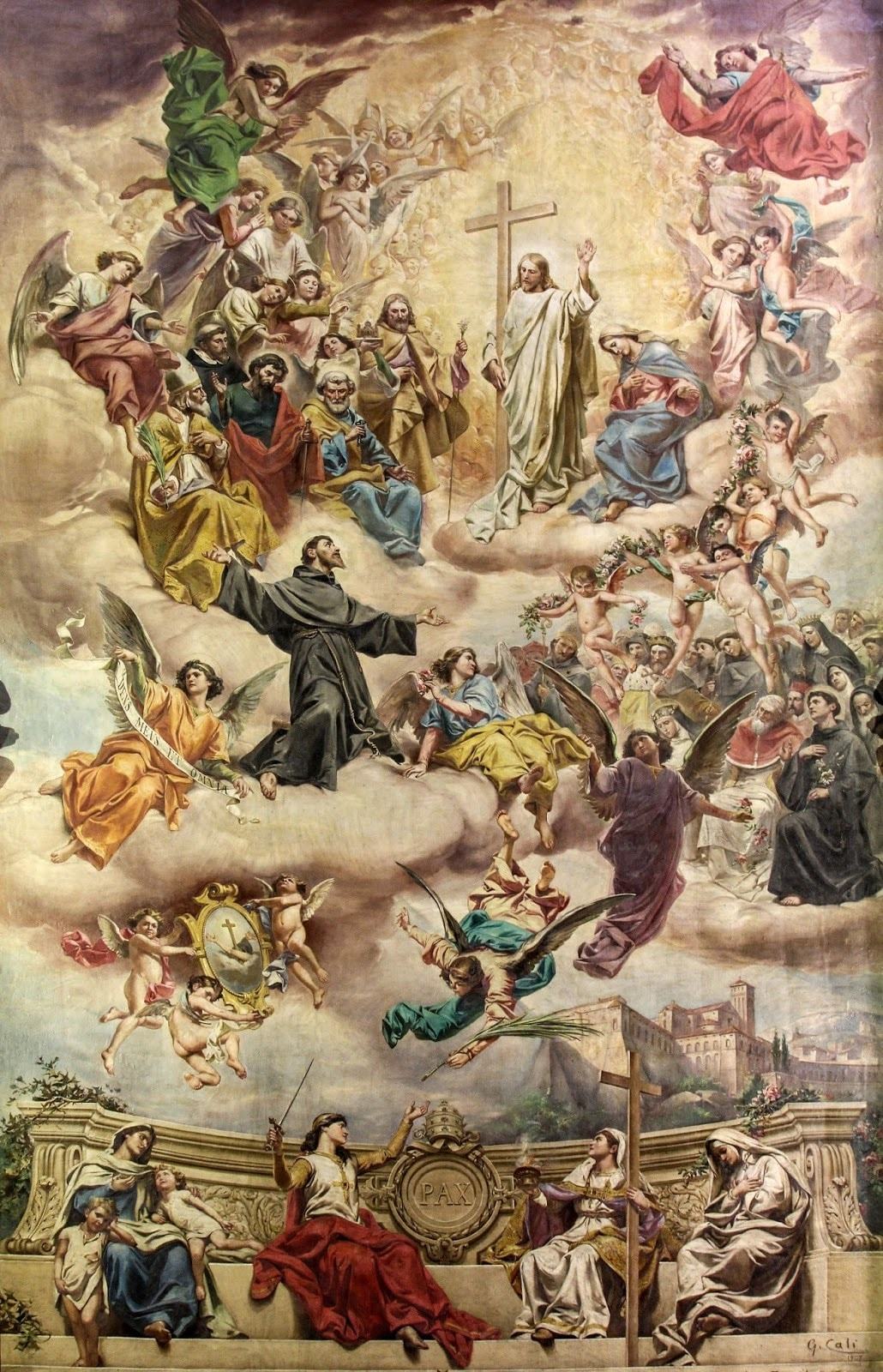
The Fourth Reflection on the Apotheosis of Saint Francis in the Church of the Conventual Franciscan Friars, Valletta
Sing, my tongue,
the Savior’s glory;
tell His triumph far and wide;
tell aloud the famous story
of His body crucified;
how upon the cross a victim,
vanquishing in death, He died.Venantius Fortunatus, Pange Lingua
A motif that may not immediately catch the eye in this painting is the garland of roses, particularly those held by the putti beneath Jesus and Mary, but also the one held by the angel beside Saint Francis, as well as the plant-like form behind the architectural structure at the bottom of the painting.
The presence of this floral motif is not accidental, but is connected with the life of this saint. Beside the Basilica of Saint Mary of the Angels—which houses the Porziuncola—there is a garden known as the Roseto, or Rose Garden. A particular endemic species of rose grows in this garden: a thornless rose whose scientific name is Rosa canina Assisiensis. According to a tradition that dates back as far as the end of the thirteenth century, one night Saint Francis threw himself naked among the bushes in this place, trembling, in order to struggle against doubts and temptations. And, so that the plants would no longer wound him, they were transformed from that moment onwards into thornless roses.

It is easy, when looking at a rose, to forget that it emerges from among thorns. And when we remember this, we dream of an ideal world where roses grow without thorns. Yet knowing that, here on earth, there exists a small corner of heaven where this miracle takes place gives rise to hope: the hope that the thorns have a value, because it is from among them that the beauty of the rose blossoms.
This is not empty optimism, but a genuine longing that good may triumph over evil, faith over doubt, and strength over temptation. May our hope never be empty idealism or a poor resignation, but may it be anchored in Jesus, who has conquered the thicket of sin and has given us the possibility that, like him, at the end of time, we too may blossom into eternal life, without thorns.