



“So Great a Cloud of Witnesses”
Second Reflection on the Panel of the Annunciation in St Paul’s Cathedral, Mdina
Therefore, since we are surrounded by so great a cloud of witnesses, let us also lay aside every weight and sin which clings so closely, and let us run with perseverance the race that is set before us, looking to Jesus the pioneer and perfecter of our faith.
Hebrews 12:1–2a
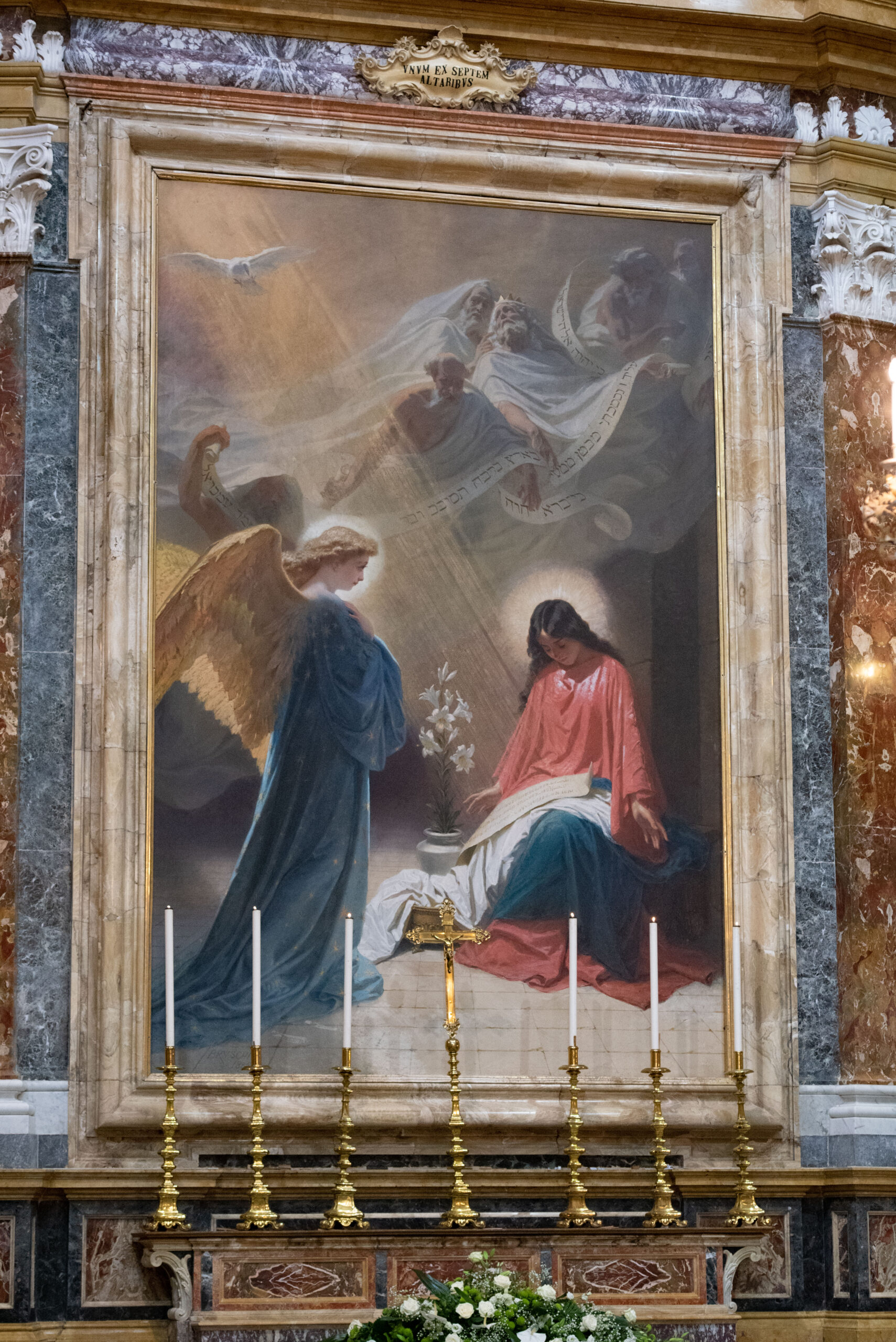
Among the many innovative elements found in Bruschi’s panel is the presence of several prophetic figures floating in the air—almost as though they form a cloud—each holding a scroll. Upon each scroll is written, in the original Hebrew, a quotation from the Old Testament which Christian tradition has understood as a foretelling of Christ’s conception, of Mary’s role within this mystery, or of her virginity.
Moving from left to right, we find:
- Isaiah, with the words “you shall call his name Immanuel” (Is 7:14), a text explicitly referred to in Matthew 1:23 in the account of Joseph’s dream;
- Jeremiah, with the words “For the LORD has created a new thing on the earth: a woman encircles a man” (Jer 31:22), a verse which the Fathers of the Church applied to the fact that Mary conceived in her womb the Son of God as man—among them St Jerome in the first book Against Jovinianus (par. 32; PL 23.256);
- King David, with the words “Upon thee I have leaned from my birth; thou art he who took me from my mother’s womb” (Ps 71:6). Although not a prophet in the strict sense, Christian tradition and devotion nonetheless consider David a prophet, especially inasmuch as the Book of Psalms is attributed to him. Moreover, David receives the promise from the prophet Nathan which St Luke also regards as a messianic prophecy (2 Sam 7:12)—the figure whispering into David’s ear in the painting may perhaps allude to this;
- Ezekiel, with the words “for the Lord, the God of Israel, has entered by it; therefore it shall remain shut” (Ezek 44:2), a verse applied as a prophecy of Mary’s perpetual virginity.
Each of these scriptural passages invites a moment of personal reflection. Yet the presence of these figures—appearing almost as spirits—deepens our sense of expectation during this holy season of Advent. Although no longer dwellers upon earth, Bruschi places them just below the heavenly light to highlight that these righteous ones were still awaiting the coming of Israel’s Redeemer so that they might enter everlasting joy. Their waiting, however, is not frustrated; it is filled with trust in the Lord, confident that the hope he inspired within them will be fulfilled.
We are always waiting, but it is a waiting in the conviction that we have already seen God’s footsteps.
Henri Nouwen, Bread for the Journey
What are you waiting for? How are you waiting?