



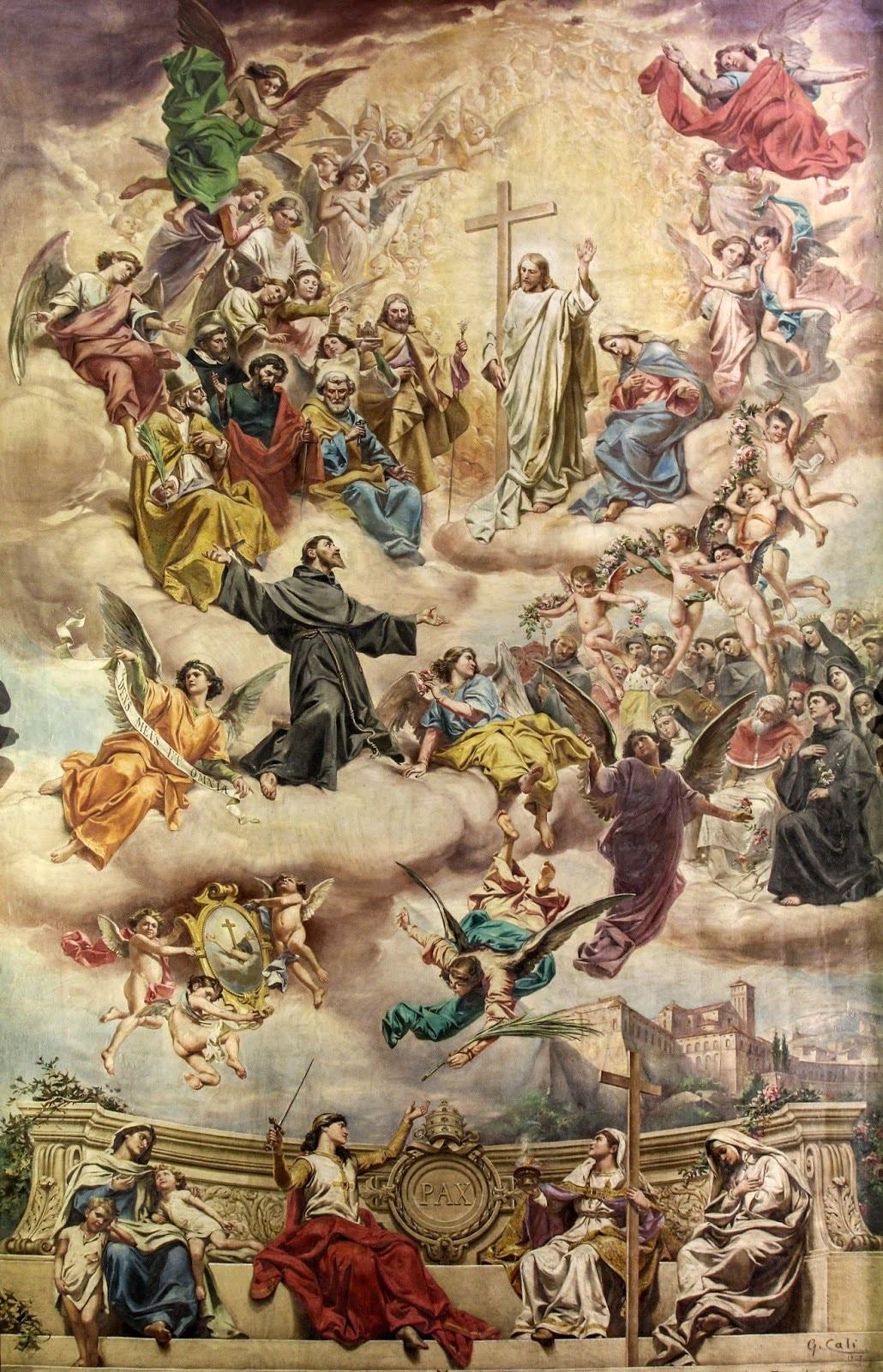
The Glory of Saint Francis
The First Reflection on the Apotheosis of Saint Francis in the Church of the Conventual Franciscan Friars, Valletta
One of the churches most frequented in Valletta—partly because of its prominent position in Republic Street—is the church of the Conventual Franciscan Friars, dedicated to Saint Francis of Assisi. The first thing that catches the eye as one enters this somewhat dimly lit church is the immense canvas above, painted by the Maltese artist Giuseppe Calì. It depicts Saint Francis entering into the glory of heaven.
The painting, together with the decoration of the rest of the ceiling, was inaugurated in 1907, in preparation for the centenary celebrations of the foundation of the Order in 1209. It is fitting, therefore, that, during this jubilee year dedicated to St Francis, we pause to contemplate this immense canvas, the work of the Maltese artist Giuseppe Calì.
Calì played an important role in the development of the decoration of Maltese churches. He introduced new trends and influences into the Maltese artistic scene, which had, to some extent, become stagnant. This depiction of the Apotheosis of Saint Francis reveals influences of Verismo and Romanticism, together with the use of Baroque conventions and the influence of Pietro Gagliardi, particularly in the choice of delicate colours.
The overwhelming majority of the figures have their gaze fixed upon Saint Francis, especially the saints and angels gathered in heaven. Among them are the Blessed Virgin Mary, Saint Joseph, Saint Peter and Saint Paul, Saint Dominic, and Saint Publius, recognisable by his episcopal vestments and the palm of martyrdom.
Yet Saint Francis does not stand precisely at the centre of the painting. At its centre lies the space between Saint Francis and Jesus, who is likewise gazing towards him, as though welcoming him into the glory of the Father.
The diagonal line formed by Saint Francis, his arms opened wide as though ready to embrace the love of his life, and Jesus, holding the crucifix in his right hand and with his left hand likewise open, forms the very heart of the painting. This encounter is the true glory of Saint Francis.
He whom Francis encountered crucified and embraced by a seraph on Mount La Verna, he now encounters face to face, risen and victorious. Yet he still bears the wounds. They no longer bleed; rather, together with the cross, they seem to have become the trophies of victory.
Here we see the mystical experience of Saint Francis on La Verna brought to its full fulfilment.
“For the glory of God is the living man, and the life of man is the vision of God.”
Saint Irenaeus, Against Heresies, 4.20.7 (PG 7.1037)
What do I consider to be my glory? Am I seeking it in the Lord? Am I allowing my wounds to meet His, so that life may spring forth from them?