



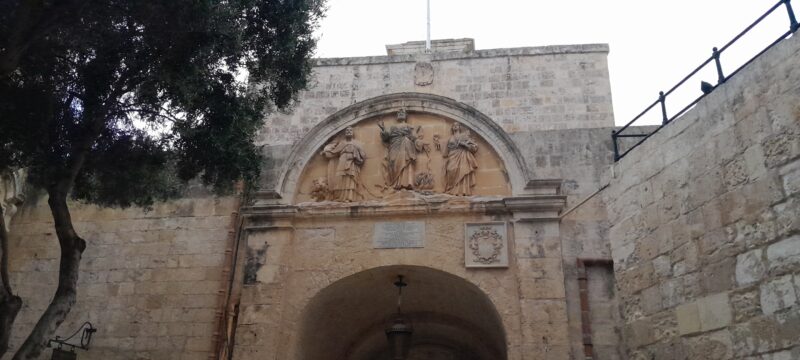
As you pass through the main gate of the city of Mdina, if you look back you will notice a relief with three figures carved into the bastions overlooking you: that of Saint Paul, of Saint Publius, and of Saint Agatha—the patron saints of Malta under whose protection our forefathers, with faith and wisdom, placed themselves and our land. Three saints whose memorials and feasts we have celebrated or will celebrate in these days: Saint Publius on 22 January, Saint Agatha on 5 February, and Saint Paul on the feast of his Conversion on 25 January and on the commemoration of his providential shipwreck on our shores on 10 February.
Three saints who, like us, lived on or set foot upon the rocky soil of our islands. Paul found himself here unexpectedly, and Publius, as prince of the island, welcomed him into his home—him and his companions who narrowly escaped drowning. Agatha too, for a time, found refuge on our islands after fleeing Sicily because of persecution. Yet, like Paul who continued his journey to Rome, Agatha did not remain here, but returned to Sicily and did not shrink from offering the ultimate sacrifice of her young life, so long as she might preserve the purity of her body and the love of her heart burning for you.
Three saints who, through deeply rooted traditions, watched over this rock as it struggled against the waves and freed it from what threatened it. We have accounts that show how, through the direct intervention of Saint Paul and Saint Agatha—whether by apparition or in a dream—the people were delivered from the edge of the Moorish sword in 1429 and, by a narrow escape, in 1551 after a prolonged Ottoman siege of Mdina.
Three saints who, even if today we may no longer seek them out as much or ask God for special graces through their intercession, still certainly have a powerful word to speak to us even now. Their actions, their perseverance to the very end, and their words—or their silence—still resound today despite the centuries that have passed. And even if we have lost trust in miracles, the concrete and resolute choices of these three saints can still free us today from the darkness of all that enslaves us and illuminate our faith and our identity. For identity does not come from logos or flags, but from the bond that unites people together, from a sense of belonging, from striving for the common good; from the gentleness and unity through which we feel at home with one another; from the gentle light of faith that has illuminated the dark nights and overcast days of our journey as a people throughout the years; from the stone, the thyme, the brine, and the rock in which this faith in you was planted, grew without its roots drying up, and bore fruit… and can continue to bear fruit, provided that we ourselves do not cast all this aside in order once again to embrace the idols of false gods—gods which, if in the time of Publius and Paul they had names and mythologies, today take the form of money, of excessive comfort that corrodes, of unrestrained indulgence and pleasure, and of selfishness. May we not find ourselves serving only ourselves and expecting everything to revolve around us and our small world, instead of recognising that it is you, the true Sun of Justice, towards whom we must turn to receive light, and that we must also have the strength to turn towards those upon whom your gracious shadow rests.