



Christian Maturity
Second Reflection on the Painting of the Meeting of St Peter and St Paul
Even to your old age I am he,
and to grey hairs I will carry you.
I have made, and I will bear;
I will carry and will save.
Isaiah 46:4
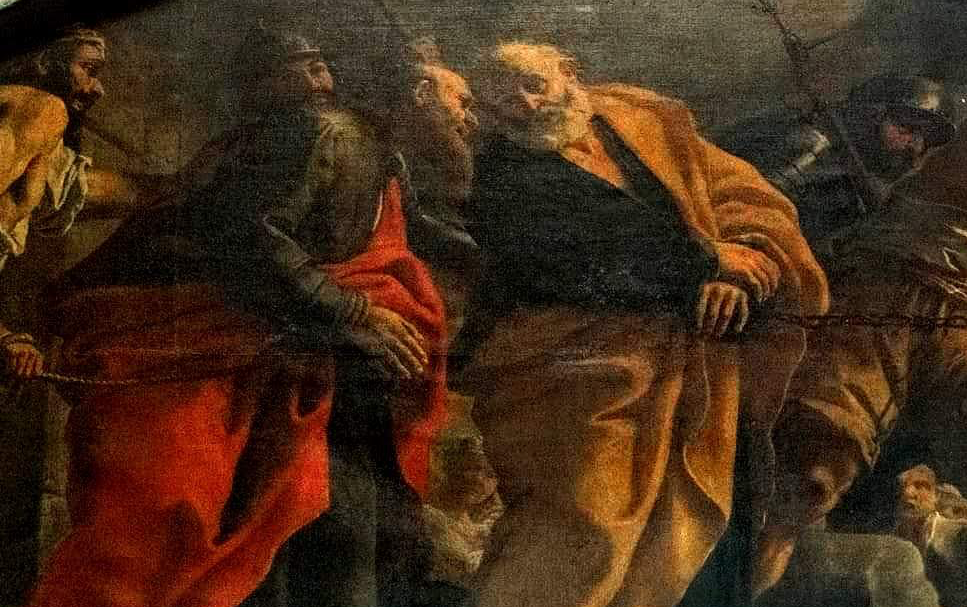
In the lunette depicting the meeting of Peter and Paul in the Jesuit Church, Valletta, Mattia Preti presents us with two men well advanced in years. Preti adopts the traditional iconography associated with these two figures: Peter with white, curly hair and beard; Paul bald, with a dark, pointed beard. Even the colours of their garments are those customarily used: Paul wears a green tunic and a red cloak, while Peter is clothed in a blue tunic and a yellow cloak. This choice encompasses all the primary colours, so that the iconographic tradition seems almost to express visually how, between them, they embrace all the varied hues of the Church’s diversity.
For these two apostles, the promise made to the righteous person in Psalm 92 holds true:
They still bring forth fruit in old age,
they are ever full of sap and green,
to show that the Lord is upright;
he is my rock, and there is no unrighteousness in him.
Psalm 92:14–15
The aged appearance of Peter and Paul reminds us of the wisdom of the Sacred Scriptures, which teach that prudence and understanding are not acquired through human ability alone, but through the passing of years and the experiences they bring. Such experiences can indeed harden the heart, yet they can also open it more fully and broaden its horizons.
In Maltese we have a saying: “Iż-żmien isajru l-bajtar”—“Time ripens the prickly pear.” In a culture that places such emphasis on eternal youth (and, at times, perpetual immaturity), on the assumed uselessness of old age, and on the desire to remove from society not only suffering but also those who suffer, Christian maturity and the deeper serenity that accompanies it can become a sign of that sweetness of fruit which is attained only when it has been properly ripened and has reached the point of almost beginning to fade.