



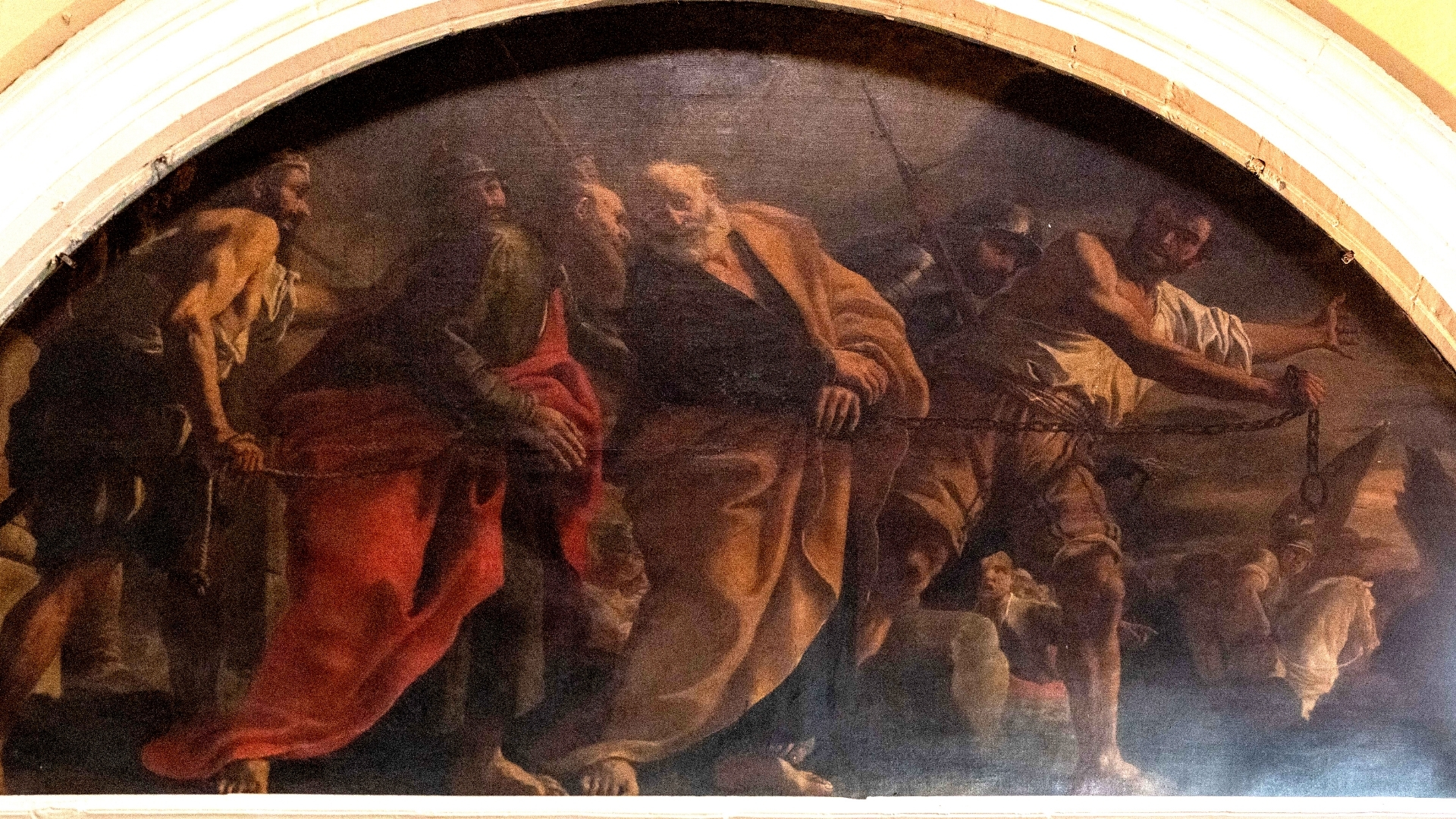
A Gaze Filled with Love
First Reflection on the Painting of the Meeting of St Peter and St Paul
Behold, how good and pleasant it is
when brothers dwell in unity!
It is like the precious oil upon the head,
running down upon the beard,
on the beard of Aaron,
running down on the collar of his robes!
It is like the dew of Hermon,
which falls on the mountains of Zion!
For there the Lord has commanded the blessing,
life for evermore.
(Psalm 133)
In the reflections that follow, we shall contemplate one of the lunettes situated beside the altar of Saint Peter in the Jesuit Church, Valletta. This work by Mattia Preti, painted around the year 1662, forms part of a cycle dedicated to Saint Peter, which includes The Liberation of Peter from Prison as the altarpiece and The Martyrdom of Peter in the opposite lunette.
In the Acts of the Apostles and in the Letters of Saint Paul, we find numerous references to occasions when these two apostles found themselves in prison. On those occasions, they were delivered because their hour had not yet come. There was still work to be done. But now the hour has arrived, the moment of trial has come.
Although there is no historical evidence , this meeting between the two apostles before their martyrdom is mentioned in certain medieval documents and is a recurring theme in Christian iconography, known as the Concordia Apostolorum. Until 1915, there was even a small chapel on the Via Ostiense in Rome commemorating this event, known as the Chapel of the Separation (Capella della Separazione).
Preti places these two protagonists at the centre of the scene, gazing at one another in an intimate dialogue (as suggested by their open mouths), while their faces—and indeed their entire figures—are illuminated by a ray of light descending from heaven, in contrast to the other figures, who remain somewhat in shadow.
From the Pauline Epistles we know that the relationship between these two apostles was not always harmonious. Yet, within that gaze is gathered the whole love of the Church, where every difference fails to outweigh love for Christ and love for the members of His Body. It is a gaze that prompts us to ask ourselves how we live conflicts within the family, within the community, and within the Church. What motivates us? Mutual love and a genuine search for the truth, or a sense of superiority and pride?