



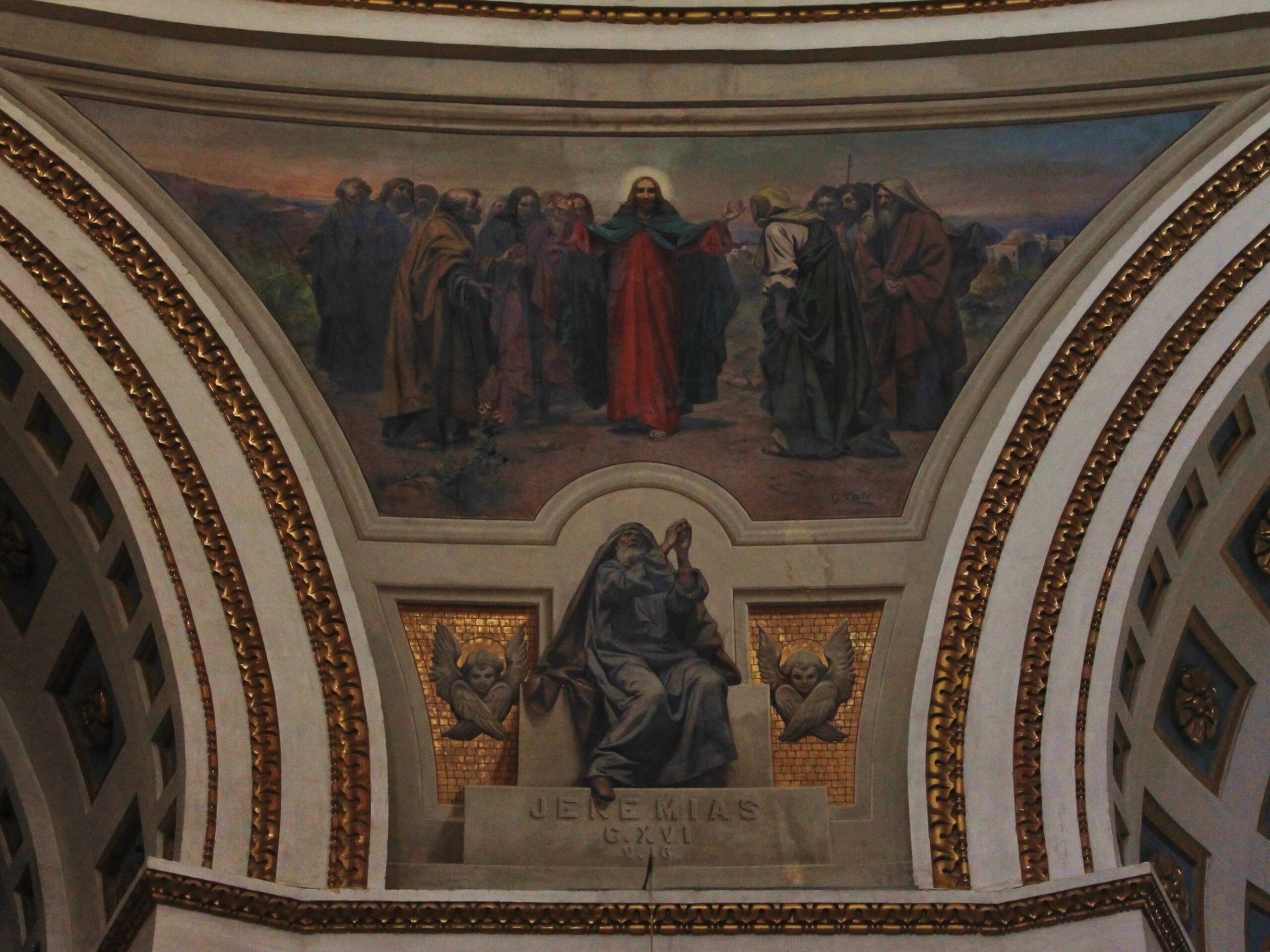
The Mission’s Landscape
Second Reflection on the Painting of Jesus with the Apostles
And now the Lord says,
who formed me from the womb to be his servant,
to bring Jacob back to him,
and that Israel might be gathered to him,
for I am honoured in the eyes of the Lord,
and my God has become my strength—
he says: “It is too light a thing that you should be my servant
to raise up the tribes of Jacob
and to restore the preserved of Israel;
I will give you as a light to the nations,
that my salvation may reach to the end of the earth.”Isaiah 49:5–6
One of the distinctive features of Giuseppe Calì’s paintings, evident also in several of the lunettes depicting the life of Christ in the Rotunda of Mosta, is undoubtedly the landscape in the background, with its modest buildings in an Eastern style. In this particular lunette of Jesus with the Apostles, upon which we are reflecting, the background serves a specific purpose: it reminds us of the breadth of Galilee, the land into which the Apostles would be sent after they were chosen.
The very word apostle, from the Greek, originally means a messenger—someone who is sent on a mission—before it came to designate a particular office within the Church. Although, at this early stage, Jesus sends the Twelve to seek “the lost sheep of the house of Israel” (Matthew 10:6, RSV), before his Ascension this mission is extended to the very ends of the earth:
“All authority in heaven and on earth has been given to me. Go therefore and make disciples of all nations, baptising them in the name of the Father and of the Son and of the Holy Spirit, teaching them to observe all that I have commanded you; and lo, I am with you always, to the close of the age.”
Matthew 28:18–20
Through Baptism, we have not only been numbered among the disciples but have also received the commission of apostles. What are the concrete “ends of the earth” to which the Lord is sending you in your own life, so that there you may live as his disciple and become his messenger?