Author: Rev Gilbert Scicluna

Water

Water plays an important role in the Easter Vigil. The solemn rite of its blessing takes place by lowering the Paschal candle once or three times into the font—the womb of Mother Church, given life by Christ so that new children may be born within her through Baptism.

Yet this water and its grace are not only for those baptised on that most holy night of the Church’s year. The water is sprinkled over the whole assembly after, with one voice, it renounces Satan and sin and renews its profession of faith in Christ. And, even for those who did not take part in the Vigil, or who may not even remember where the church door is … even for them there is water enough during these fifty days, as priests and deacons visit the homes and families of our parishes so that, through the sprinkling of water wherever they are welcomed, the peace of the Risen Christ and the freedom he brings may be shared.

What does the colour white represent?

During Eastertide our churches are clothed in white, and the priest wears white vestments at Mass. In the mystery of Easter, what the prophet Isaiah foretold comes to pass: even if our sins are like scarlet and crimson, they become white as snow and wool … the wool of lambs, the colour of the Paschal Lamb. Even when Jesus was transfigured before Peter, James and his brother John, to show them who he truly was—the beloved Son in whom the Father has always delighted—the Evangelists tell us that his garments became “white as light” (Mt 17:2), of a “dazzling whiteness” (Lk 9:29), so much so that “no fuller on earth could bleach them so white” (Mk 9:3)—for this whiteness was a foretaste of the radiance of heaven (see Dan 12:3).

Yes, white continues to be used throughout the fifty days because, even if for us Maltese Easter can seem like the outing after the feast (ix-xalata), following Lent and Holy Week, in truth Easter is the feast. That is why we call it the Great Feast—the feast of feasts. And this holds for the whole of Eastertide, and for our entire life, because although it is woven of moments marked by sorrow and others filled with joy, as we are taught to sing, we carry within all this the white garment we received at Baptism. As a sign of our dignity as children of God, we are called to keep it unstained until eternal life.

The Light and the Paschal Candle

During the Easter Vigil, the contrast between darkness and light is very striking: the church lies almost entirely in darkness and, suddenly, at the proclamation of the coming of Christ’s light and the glory of his Resurrection, the light is kindled. Yet before that appearance of brightness and radiance, the silence and darkness of Holy Saturday begin to be broken by the small flame of the Paschal candle—that tall candle, symbol of the Risen Christ—followed by the priest and the people. It is lit from the newly blessed fire outside the church and, for the first time, the acclamation is sung: “The light of Christ,” and we all reply, “Thanks be to God,” until we too light our small candles from the Paschal candle, so as to share in this holy light and follow Christ, for, as he himself told us: “He who follows me will not walk in darkness, but will have the light of life” (Jn 8:12).

Therefore, if during these days you go to church to take part in Mass and see the Paschal candle lit, be assured that it is not by mistake, for it is Eastertide! Indeed, all the more so because, as Jesus himself promised us: “As long as I am in the world, I am the light of the world” (Jn 9:5). And this so that, as the priest declares while lighting the Paschal candle: “May the light of Christ, who has risen in glory from the dead, dispel the darkness of our hearts and minds.”

The Octave of Easter

Fifty! Because the Church does not begin preparing for the next Christmas and Holy Week on the day after Easter, but instead spends fifty days celebrating and delving ever more deeply into the mystery of our salvation, rejoicing in the new life we have gained in Christ through his resurrection from the dead.

But before the fifty comes the eight: the octave. Eight days, from Easter Sunday to the Second Sunday, because the celebration of Easter is so great and so important for us Christians that, for eight full days, the Church lives each day as though it were Easter Sunday. During the octave, each day we hear proclaimed one of the events found in the Gospels connected with the resurrection of Jesus, and at the same time we begin to be drawn into the spirit of how the first Christians started to live and celebrate this resurrection after the coming of the Holy Spirit at Pentecost.

The Octave of Easter—not because we are “otto,” as the Maltese adage goes, but because we are truly as God wills us to be: reunited with him through the death and resurrection of Christ!

Why is Rose used on the Fourth Sunday of Lent?

The liturgical colour used during Lent is purple, a sober color that recalls the penitential character of this season. But on the Fourth Sunday of Lent—halfway through the six weeks marked by sacrifice and the call to conversion—churches are dressed in pink. This Sunday, like Gaudete Sunday of Advent, is characterized by joy. Likewise, it takes the name of Lætáre Sunday because the entrance antiphon of the Mass for this Sunday begins with the words “Lætáre Jerúsalem”: “Rejoice with Jerusalem and be glad for her, all you her friends; leap for joy, all you who shared her sorrow; so you will rejoice and be filled with her consolation,” taken and adapted from the Book of the Prophet Isaiah 66, 10-11.

Unlike the other days of Lent, as on solemnities, on this Sunday flowers can also be used on the altar (Sacred Congregation for Divine Worship, Circular Letter on the Preparation and Celebration of the Lord’s Passover, Paschales Solemnitatis, 16 January 1988, par. 25). Actually, the liturgical colour is not pink but rose—a shade of pink sometimes referred to as “old rose” in English. Despite it is characterized by light—in Year A, the Baptismal cycle—white is still not used because “it is not a cloudless sky we contemplate on this Sunday.” This light that leads us to see brings with it challenges and difficulties, as experienced by the blind man when he received the light of faith and was expelled from the synagogue by the Jews because he confessed his belief in Jesus who gave him light (see Congregation for Divine Worship and the Discipline of the Sacraments, Homilical Directory, 2015, par. 73-74).

In the other liturgical years, the readings also revolve around this same theme of joy. In Year B we find ourselves in a scene of darkness: Nicodemus who goes to Jesus at night in the hope of obtaining some light. And even Jesus speaks again about light in a struggle with darkness:

“this is the judgment, that the light has come into the world, and men loved darkness rather than light, because their deeds were evil. For every one who does evil hates the light, and does not come to the light, lest his deeds should be exposed. But he who does what is true comes to the light, that it may be clearly seen that his deeds have been wrought in God.”

John 3:19-21

But it is precisely in this account that we find one of the most powerful sentences found in the Gospels and which we can say summarizes the entire Good News: “For God so loved the world that he gave his only Son, that whoever believes in him should not perish but have eternal life.” (John 3:16).

In Year C, we encounter a story of sorrow and joy of a family in which the son leaves far away but returns to the bosom of his father who has not stopped waiting for him, while the father also goes out to meet the eldest son who was unhappy with the treatment that the father gave his brother … both were dead and at that time were given the chance to rise again, they were lost—some far away and some in their own home—and now they could be found.

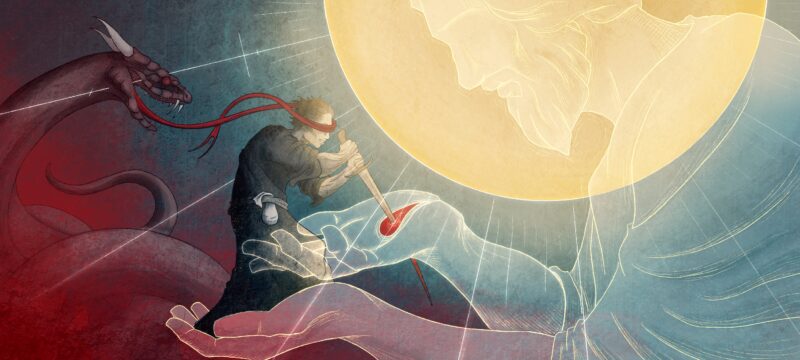
“Ġesù tiegħi, idejk min niffed?” – who held the nails to pierce your hand …

The other day I came across this image and couldn’t help but remember a hymn that undoubtedly stands out in this time of Lent: the hymn Ġesù tiegħi, particularly the verse that goes:

Ġesù tiegħi, idejk min niffed
b’dawk l-imsiemer tal-ħadid?

Kienu l-ħafna dnubiet tiegħi.
Ġesù twajjeb, aħfer u ħenn.

a litteral translation from Maltese to English would read something like this: My Jesus, your hand who pierced / with those iron nails? / It was my many sins. / Good Jesus, forgive me and be merciful.

Although it is strictly not a liturgical hymn but a devotional one, it still resonates with us so deeply throughout Lent. However, this is not simply a traditional Maltese hymn. Actually, it was composed—words and melody—by St Alphonsus Maria de’ Liguori (1696–1787). It seems that the original name of the hymn was Alla Passione di Gesù Cristo, and the earliest publication we know of dates to 1738, in the book Via facile e sicura del Paradiso by the Neapolitan priest Don Gennaro Maria Sarnelli (1702–1744), who was a close friend and collaborator of St Alphonsus. Even an adaptation of the words of this hymn exists also in English under the title My Jesus! Say what wretch has dared (although there are different melodies, and the closest to the original is still heavily altered).

Perhaps some may find this hymn too boring or dull. And this is somewhat true… but, precisely because this is true, we need to hear it more, to sing it, to meditate upon it, and truly pray it. Antonio Maria Tannoia (1727–1808), a Redemptorist priest and the first biographer of St Alphonsus, writes that, before Eucharistic adoration, the saint would often sing this hymn, and his deep devotion, combined with his sweet and passionate voice, bore more fruit in the hearts of the gathered faithful than even his own sermons.

And indeed: with its melody similar to a funeral march and lyrics formed by a series of rhetorical questions, all having the same answer, how can we remain cool and untouched? How can it fail to make us aware that it wasn’t simply the Jews or the Romans who were the wicked guys responsible for Christ’s death, but the sin of humanity, the sins of all men—past, present, and future—that truly led God to become man, so that He could take upon Himself our sins and carry them HIMSELF, so that we might be ransomed and enjoy the saving grace of His great mercy!

Yes, my sins were already present in the depths of His soul at that very moment, before I even began to exist. My sins, too, which are many, were the ones that nailed Christ to the cross and subjected Him to all that torment. But ultimately, it was the same infinite love of Him who, not only suffered the offense of our transgressions, but also paid the highest price to ransom and win us back, that held him fast to the cross!

The Word of God during Lent

During the Lenten season, the Church gives great importance to the Word of God, in the faith and hope that its proclamation will lead to conversion. We see this taking place in various ways, for example through Lenten retreats and sermons—offered in different formats according to circumstances—through devotional prayer that contemplates the mystery of Jesus’ Passion and Death for our redemption, and above all through the proclamation of the Word of God during the Liturgy.

If we consider the passages chosen by the Church to be read at Mass, we notice that there are not two weekday cycles for the First Reading (Year I and Year II). Instead, there is a single cycle in which the Old Testament reading is paired with a passage from the Gospel in order to address various themes connected with the spiritual importance of this liturgical season. Then, from the day after the Fourth Sunday of Lent, there is a semi-continuous reading of the Gospel according to Saint John, which leads us in a dramatic way towards the celebration of the Lord’s Passion.

On the Sundays, however, we still have the usual three-year cycle—Years A, B, and C. On the First and Second Sundays we always hear the accounts of the temptations in the desert and of the Transfiguration, taken from the Synoptic Gospels, according to the year in question. But on the three Sundays that follow, in Year A we find three Gospels connected with the celebration of the Scrutinies, which form part of the rites preceding the celebration of the Sacraments of Christian Initiation at the Easter Vigil. From the earliest centuries, for these Sundays the Church chose three accounts from the Holy Gospel according to Saint John through which both those who are preparing for Baptism and the community that will welcome the newly baptised are led more deeply into the heart of the mystery of these sacraments, by which we are united to Christ who died and rose again.

Therefore, as we are in Year A, on the Third Sunday we hear proclaimed the Gospel of the Samaritan woman, in which Christ is revealed as the living water; on the Fourth Sunday, the account of the man born blind, during which Christ shows himself as the true Light; and finally, on the Fifth Sunday, the account of the raising of Lazarus, as an image of how Christ grants new life through Baptism.

Why come we have 3 patron saints

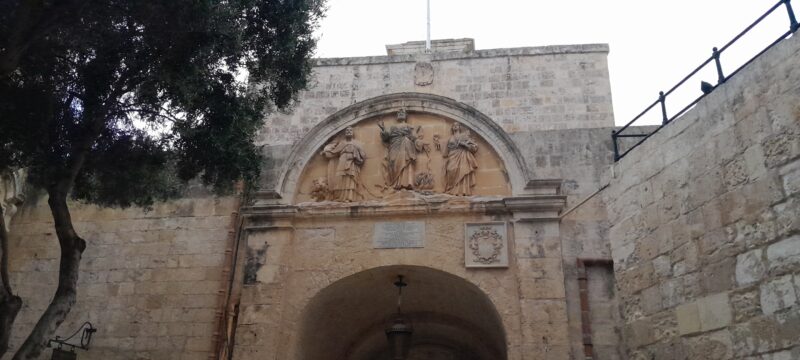
As you pass through the main gate of the city of Mdina, if you look back you will notice a relief with three figures carved into the bastions overlooking you: that of Saint Paul, of Saint Publius, and of Saint Agatha—the patron saints of Malta under whose protection our forefathers, with faith and wisdom, placed themselves and our land. Three saints whose memorials and feasts we have celebrated or will celebrate in these days: Saint Publius on 22 January, Saint Agatha on 5 February, and Saint Paul on the feast of his Conversion on 25 January and on the commemoration of his providential shipwreck on our shores on 10 February.

Three saints who, like us, lived on or set foot upon the rocky soil of our islands. Paul found himself here unexpectedly, and Publius, as prince of the island, welcomed him into his home—him and his companions who narrowly escaped drowning. Agatha too, for a time, found refuge on our islands after fleeing Sicily because of persecution. Yet, like Paul who continued his journey to Rome, Agatha did not remain here, but returned to Sicily and did not shrink from offering the ultimate sacrifice of her young life, so long as she might preserve the purity of her body and the love of her heart burning for you.

Three saints who, through deeply rooted traditions, watched over this rock as it struggled against the waves and freed it from what threatened it. We have accounts that show how, through the direct intervention of Saint Paul and Saint Agatha—whether by apparition or in a dream—the people were delivered from the edge of the Moorish sword in 1429 and, by a narrow escape, in 1551 after a prolonged Ottoman siege of Mdina.

Three saints who, even if today we may no longer seek them out as much or ask God for special graces through their intercession, still certainly have a powerful word to speak to us even now. Their actions, their perseverance to the very end, and their words—or their silence—still resound today despite the centuries that have passed. And even if we have lost trust in miracles, the concrete and resolute choices of these three saints can still free us today from the darkness of all that enslaves us and illuminate our faith and our identity. For identity does not come from logos or flags, but from the bond that unites people together, from a sense of belonging, from striving for the common good; from the gentleness and unity through which we feel at home with one another; from the gentle light of faith that has illuminated the dark nights and overcast days of our journey as a people throughout the years; from the stone, the thyme, the brine, and the rock in which this faith in you was planted, grew without its roots drying up, and bore fruit… and can continue to bear fruit, provided that we ourselves do not cast all this aside in order once again to embrace the idols of false gods—gods which, if in the time of Publius and Paul they had names and mythologies, today take the form of money, of excessive comfort that corrodes, of unrestrained indulgence and pleasure, and of selfishness. May we not find ourselves serving only ourselves and expecting everything to revolve around us and our small world, instead of recognising that it is you, the true Sun of Justice, towards whom we must turn to receive light, and that we must also have the strength to turn towards those upon whom your gracious shadow rests.

The voice of the Beloved awaits a response

Maltese has some very beautiful expressions that link our relationships with one another to the spoken word. When two people begin to fall in love, we say: “Look at him, he’s talking to a girl.” When two people are in disagreement, we say: “Look at them, they’re not speaking at the moment.” This shows that where there is dialogue, there is also relationship.

From the very beginning of creation, it was God’s delight to “walk in the garden in the cool of the day” and to seek out the human person in order to speak with him (Gen 3:8). Sin abruptly brought this dialogue between God and humanity to a halt. Humanity fell silent and hid itself, but God, in his boundless love, prepared a plan to break the silence and to reach humanity through his Word.

Since God is a God of relationship and love, he wished to continue speaking with us at all times. The tragedy of sin neither restrained him nor prevented him from speaking.

In the sacred books, the Father who is in heaven meets His children with great love and speaks with them … For Sacred Scripture is the word of God inasmuch as it is consigned to writing under the inspiration of the divine Spirit.

Dei Verbum, nos. 21; 9

The Word of God is so powerful that, when it is spoken, it comes to pass. We see this in creation: each time God spoke, he created. What God willed came to be and, in its fullness, took flesh in Christ. “In the past God spoke to our ancestors many times and in various ways through the prophets; in these last days he has spoken to us through his Son” (Heb 1:1–2). It is no coincidence that in the Gospel according to St John, instead of a narrative of Jesus’ birth, we find the narrative of the Word (the Verb or Logos) in the person of Christ.

St George Preca placed a special emphasis on the words spoken by Jesus, calling them “the voice of the Beloved”. He encouraged children to fall in love with the Word of God. Why? “For God so loved the world that he gave his only Son, so that everyone who believes in him may not perish but may have eternal life” (Jn 3:16). For this to happen, it is now up to us—those for whom Christ came—to speak. How? By allowing our lives to become a fitting response to this Word through our actions.

God does not want to speak alone. He wants to enter into dialogue with us. God is waiting for us to commit our lives so that they may become a faithful response, in the way we live and in the way we speak. On this Third Sunday in Ordinary Time, as we celebrate the Word of God, let us renew this love for the Beloved by spending more time with Sacred Scripture, because through it alone we can be sanctified and become more like Christ. There is no more fitting response for this special day than to contemplate this Word which has the power to transform our lives, so that we ourselves may become the delight of the Beloved!

“Il-Festi t-Tajba!” does not mean “Season’s Greetings!”

In Maltese we have several phrases through which we express our good wishes for Christmas. There are direct expressions such as “Il-Milied it-tajjeb!” (“Merry Christmas!”) and then “Is-sena t-tajba!” (“Happy New Year!”) once 25 December has passed. On cards and in official letters we generally combine Christmas and New Year wishes. Then we also have generic expressions such as “Awguri!” or “All the best!”—the latter probably more common among the more “mature” generations.

But “Awguri!” and “Ol di best!” for what, I ask? Perhaps, some might say, so as not to hurt anyone’s feelings. True, but then we risk falling into the absurdity of celebrating without having any reason to celebrate. And, after all, why should it be offensive for me to celebrate something I believe in, and for others to rejoice with me? I too wish others joy and happiness in a celebration which may mean nothing to me but is meaningful to them. I respect it and I acknowledge it!

So perhaps it is better to say “Il-festi t-tajba!” because that is certainly neutral! … But is it really so? “Il-festi t-tajba!” is not the equivalent of “Season’s Greetings” in English, as some might believe, as though good wishes were simply part of the decorations that stay up for weeks on end, as if the Christmas season has neither a beginning nor an end. We Christians, who are supposed to know what we are celebrating and truly believe in it, say “Il-festi t-tajba!” in Malta precisely because we believe that the mystery we are rejoicing in during these days is so great that it cannot be contained within a single celebration.

After the spiritual preparation of Advent, 25 December is only the beginning! We begin by celebrating the birth of God made man, and we continue to rejoice in this for a full eight days, known as the Octave, during which we celebrate a number of feasts connected with this great birth. We start with Saint Stephen on 26 December, who was the first to be born into heaven after the death and resurrection of Jesus. Then comes Saint John the Evangelist and the disciple closest to Jesus, who, instead of a birth narrative, opens his Gospel with an elaborate theology of this mystery, expressed in poetic language. There is also the massacre of the Innocents by Herod, who, without realising it, were made sharers in the work of redemption. And of course, we cannot fail to celebrate the Holy Family!

These eight days conclude with the Solemnity of Mary, Mother of God, in which we also remember the circumcision of the child after eight days, according to Mosaic law, and the giving of the name “Jesus,” which in itself means salvation.

And, if you think that all this is enough to convince you how many feasts we have to rejoice in, be patient, because the greatest is still to come—il-kbir għadu ġej! Although in our country it has lost some of its prominence, the Epiphany of the Lord—the manifestation of Christ to the nations represented by the Magi—is liturgically considered to be on the same level as Christmas. Indeed, traditionally it was given even greater importance, to the extent that the main churches of our island were decorated almost for the titular feast for the Epiphany rather than for Christmas. We see this emphasis also in the different rites of the East, precisely because we rejoice not only with the birth of the Saviour of the world, but even more because he was revealed to us who are not part of the Jewish people, but are children of the nations upon whom the Light has shone and driven away the darkness. In the Latin Rite, this solemnity is extended until the Feast of the Baptism of the Lord, when the Father revealed Jesus as his beloved Son.

With good reason, then, we say “Il-festi t-tajba!” because, through a series of feasts, we celebrate one mystery in its many aspects. And this mystery is so great that, yes, we wish “Il-festi t-tajba!” even to those who do not share our faith, because we also wish for them to taste the sweetness of God’s love for all humanity.