

Author: Rev Gilbert Scicluna

Advent and the Babylonian Exile: how are they related?

The Season of Advent: A time of training in patience and hope, a time of preparation and waiting for the adventus, for the coming of the One desired by all the nations. A season which, before being a preparation for the celebration of Christmas, is a time that sets us in right disposition before God, rekindling the path for us if we have somewhat strayed from it, and reminding us also of the second coming of Christ at the end of time, and of the earnest and watchful expectation of the face-to-face encounter with Him who took on a human face like ours—fair and radiant because free of every stain of sin, yet who in the end became without form or comeliness to behold, precisely so that this renewed meeting with God might once more become possible for us.

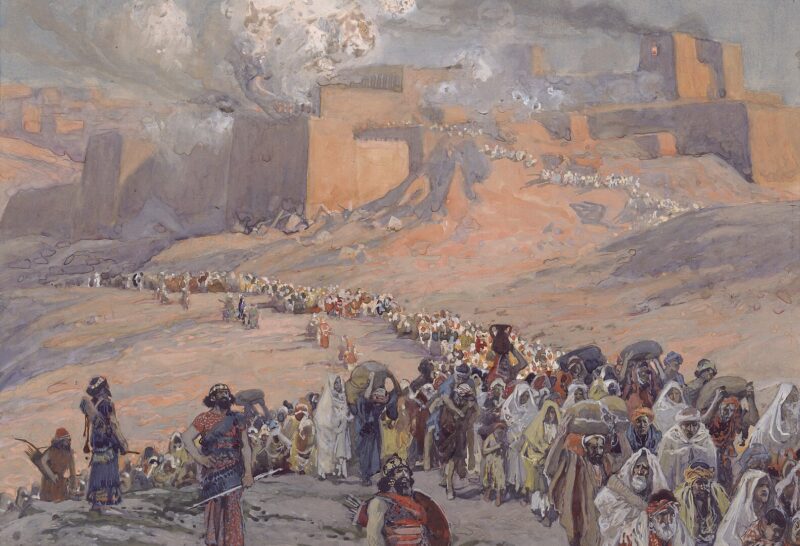
If the liturgy and spirituality of Lent drink from the wellspring of the experience of the Jewish people in the Exodus—of bondage and deliverance from Egypt, of the forty years in the wilderness—leading to the celebration of Easter through the shedding of the blood of Him who was truly the Lamb of God, who alone could take away the sins of the world; in a similar way, above all through the prophecies taken from the Book of Isaiah, through various prayers and hymns, we may say that, during Advent, the Church as it were leads us through the experience of the exile in Babylon which occurred in the sixth century before Christ: an experience marked by God’s warnings through his prophets to turn back from evil ways so as to be spared the political consequences; by the shock which the exile itself brought with it; and by the hope of deliverance when the shifting powers in the East began to show that God truly would fulfil His promise that, after seventy years, the people would return to their land and rebuild the city of Jerusalem and the Temple.

In this particular liturgical season, the exile becomes an image of the human condition estranged from God because of sin, and in need of a Saviour and Redeemer to lead man back from the way of the desert to his own land—to the place where he is rightly set, at home with himself and with God. The prophecies and promises of the return from exile become an echo of the Messianic expectation that began to mark the people of the Old Covenant in the last centuries before the coming of Christ … an expectation into which each year we enter anew—first by reckoning with our life and our concrete circumstances, not in discouragement or fear but in hope and trust—so that we may again live the waiting for the Deliverer of Israel as though Jesus had not yet been born and we were yearningly awaiting the night of Christmas, that we may rejoice in his visitation from on high like the rising sun!
100 Years since the Establishment of the Feast of Christ the King

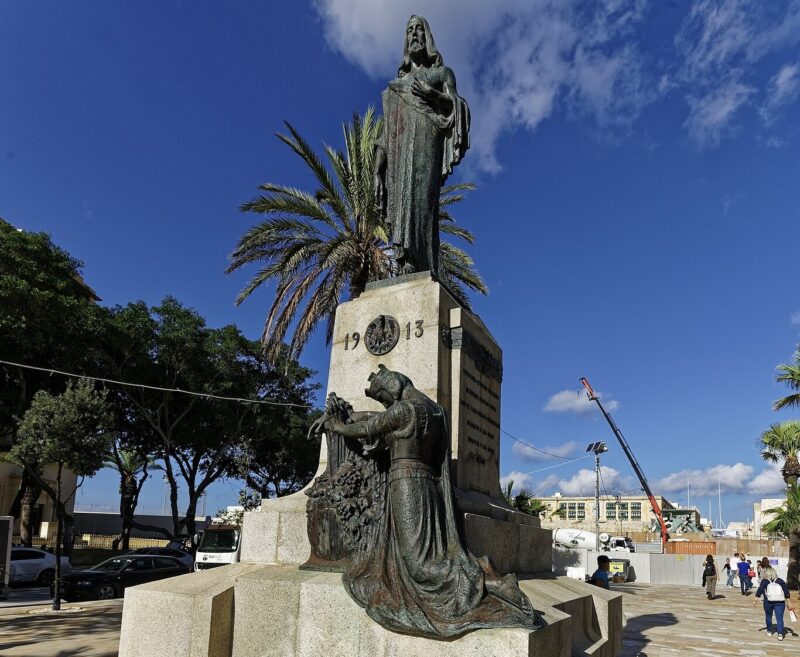
This year’s celebration of the feast of Our Lord Jesus Christ, King of All Creation, is the hundredth since it was established in 1925 by Pope Pius XI through the encyclical Quas Primas. The Pope decreed that this feast was to be celebrated throughout the whole world, every year, on the last Sunday of October, that is, the Sunday before the feast of All Saints. The Pope also ordered that, on this day each year, Christians should renew their consecration — and that of the whole world — to the Sacred Heart of Jesus.

This feast was instituted at a time of turmoil across the world, sometimes as a consequence of the rejection of faith, both on a personal level and on a collective one. The context of the post-First World War, apart from the absence of lasting peace among peoples, was also marked by an accelerated process of secularisation—at times aggressive and harsh—which paved the way for extreme ideologies hostile to the ecclesial institution and which even led to an assault on the dignity of every human being, realities that degenerated and brought about yet another global conflict.

Against this political background, Pope Pius XI felt the need to emphasise strongly the sovereignty of Christ over the whole world and to remind all that no authority could be separated from God.

The Last Things: whoever thinks about them never sins …

The solemn feast we celebrate to honour the merits of all God’s saints together, and the solemn commemoration of the faithful departed during the first two days of November, seem to set the tone and devotion of this month on the note of the reality of death and what comes after it. A symphony which reaches its conclusion with the Solemnity of Our Lord Jesus Christ, King of the whole of Creation—the One whom death will bring us to meet. Thus, the melody, though perhaps somewhat sombre, is one of hope and serenity, because we who believe know who truly awaits us at the end of this journey: Jesus Christ. It is not for nothing that in the hymn of praise Te Deum, the Church sings:

You will come, so we believe, as our Judge.

And so we ask of you: give help to your servants, whom you set free at the price of your precious blood.

Number them among your chosen ones in eternal glory.

In the Liturgy of the Hours, for the 8:00 a.m. hour, Saint George Preca asked the members of the society he founded to stop and meditate on the Last Things – that is, the final realities. A short, concise meditation, yet truly filled with meaning:

“It is certain that I shall die. When, I do not know. And only once. The moment I die, I shall be judged on all the deeds of my life, and the sentence given to me will surely be one of these two: either eternal joy or eternal suffering.”

Dun Ġorġ would also reflect on these last things, insisting that whoever thinks about them never sins—a phrase many of us probably remember from catechism classes in the M.U.S.E.U.M. groups.

As we continue to pray for our dear departed, that the Lord may soon welcome them into His eternal joy, may this also be a time for us to remember that we too must one day die and pass through all this. Yet, may we not allow this thought to lead us into circles of sadness or despair, but rather, during these weeks, let us renew our faith in our resurrection to life through Him who is the Alpha and the Omega, the Beginning and the End, and let our lives be renewed by this profession of faith.

Figolli, Bones, and All Souls

If Saint Paul were to write a letter to the Maltese, he would surely have to repeat what he once wrote to the Philippians: “their god is the belly” (Phil 3:19) . It is striking how every liturgical season has its own foods and, above all, its own sweets. Let’s be clear: this is something found in many cultures, especially Mediterranean ones. Yet on these two tiny islands, where diabetes is the national health problem, one can only marvel at how—perhaps because we were ruled by so many—we’ve inherited a bit of everyone’s culinary and confectionary traditions. Even for this time of year, besides Saint Martin’s bags filled with nuts and fruits, we also have the għadam tal-mejtin (“bones of the dead”)—neither dry nor soft, but certainly disappearing faster than the smallest real bone could ever decompose!

Apparently, we love the taste of figolli so much—especially the homemade ones—that we can’t bear to wait a whole year for them. Some people even freeze them, so that during the leaner months they can profit from the abundance that almost overwhelms us at Easter, particularly if we kept Lent without sweets. But after all, the għadam tal-mejtin are really figolli too: instead of the shape of a lamb (or any other form devoid of meaning), they take the shape of a bone.

Yet this link between Easter and All Souls’ Day—fossilised, so to speak, in bones and figolli—is not merely a charming coincidence. It has deeper theological roots touching the very heart of our faith. Spread almost evenly through the year, these two celebrations remind us of the belief we profess every Sunday in the Creed. Besides proclaiming our faith in the resurrection of Jesus, according to the Scriptures, after his bitter passion and cruel death on the cross for our salvation, we also profess that we believe in the resurrection of the dead. And this is no casual addition, inserted merely to give composers another movement to set to music. It is an essential part of our Easter faith, because just as Christ died and rose again with the same body—now glorified—so we too, at the end of time, shall share in this glory and in the eternal joy of God with our whole selves, composed not only of soul but also of body.

No one can say exactly what will remain of our bodies by that day, whose hour is hidden, and surely we would all wish for a body somewhat better and less frail than the one we have now. Yet yes, we too shall share the same destiny as Christ. Indeed, this is precisely why Christ became man: to take upon himself what is ours, so that we might share in what is his.

Therefore, while it is good to practise moderation in our sweets and to allow God’s plan to unfold without hastening too eagerly the hour of our death, it is also good that, with every bite of these “bones” we enjoy at this time, we remember our loved ones and commend them to the Lord—that he may soon let them taste the sweetness of his presence. And why not? Let us also remind ourselves of that sweet and blessed hope in which we believe.

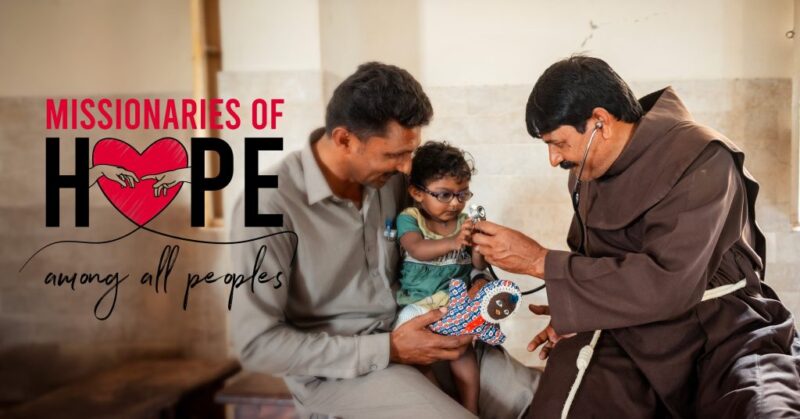
Missionaries of Hope Among all Peoples

During this month of October, through the prayer of the Rosary, we place ourselves in the hands of Mary, just as she hastened to the hill country to visit her relative Elizabeth—both to serve her and to share with her the marvellous things that God was doing in her and through her. In the same way, together with her, we too run through the streets of the world as we commemorate the 99th World Mission Day.

In this Jubilee Year, this journey as pilgrims of hope must lead us to become missionaries ofhope. Because how can one truly say they have encountered the Lord and experienced the sweetness of His mercy and love, if that encounter does not overflow outward—if the return journey from the pilgrimage does not become a path filled with hope, lighting the flame of hope wherever it passes?

Therefore, this year the Church is inviting us to be:

Missionaries of Hope Among all Peoples

Pope Francis, Message for World Mission Day, 25 January 2025

What does this mean? It means that, “In following Christ the Lord, Christians are called to hand on the Good News by sharing the concrete life situations of those whom they meet, and thus to be bearers and builders of hope” (ibid.).

It means that, in practice, we live what the Second Vatican Council powerfully affirmed: that “the joys and hopes, the grief and anguish of the people of our time, especially of those who are poor or afflicted, are the joys and hopes, the grief and anguish of the followers of Christ as well. Nothing that is genuinely human fails to find an echo in their hearts” (Gaudium et Spes, par. 1).

Let us then, with all this in our hearts—our joys and sorrows, but also the joys and sorrows of all humanity—turn to the Lord Jesus, who in His great mercy has given us new birth into a living hope through His resurrection from the dead (cf. 1 Pt 1:3), and let us run with Him through the streets of the world.

Let us turn to Him to drink from the source of life that is His Word and the Sacraments, so that the hope we offer may be the hope we ourselves have received from God. And, like Him, let us offer it simply to others, by bringing them the same comfort that God gives us (cf. 2 Cor 1:3-4).

We must once again place our hope in Him, and from this foundation, we will truly be able to go out to all nations, so that He alone may become the one true Hope of all humanity.

Photo: https://missio.org.mt/donate/projects/health/gm2025/

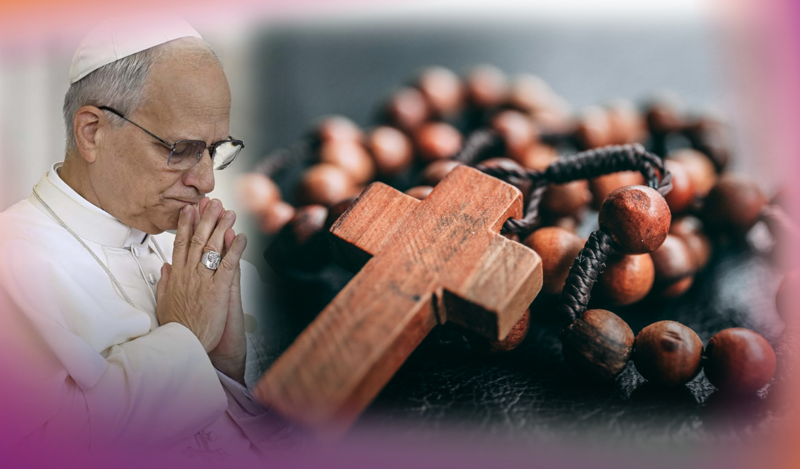
Pope Leo XIV: “Pray the Rosary for Peace”

We have begun the month of October, the month associated with devotion to and the Marian prayer of the Rosary—a prayer through which we contemplate the mystery of Christ through the eyes of His Mother and our Mother, Mary. During the general audience on Wednesday, 24 September 2025, Pope Leo XIV invited Catholic Christians to pray the Rosary daily throughout this month—personally, with the family, and in community—and to offer it for peace in the world.

Undoubtedly, what comes to mind immediately is the genocide currently taking place in the Gaza Strip and, in a more subtle way, the seizure of control of the other Palestinian territory stretching from the east of Jerusalem to the Jordan River. We also think of the ongoing conflict between Russia and Ukraine, which has now lasted for more than three years.

This topic is also being discussed at present during the 80th General Assembly of the United Nations. These two wars—especially the one currently afflicting the Palestinian people—are receiving particular attention. But what struck me most was the speech by the representative of the Holy See, Archbishop Paul Richard Gallagher, Secretary for Relations with States and International Organisations within the Secretariat of State. His words closely align with the Pope’s appeal to pray the Rosary for peace throughout October.

What touched me most about Archbishop Gallagher’s speech wasn’t any emotional or impassioned tone. It was the way this English prelate, in the context of wars waged under the pretext of religion, unequivocally recalled the first words spoken by Pope Leo XIV to the city and to the world following his election:
“Peace be with you all! … A peace without weapons, a peace that disarms—humble and persevering.” Peace is not achieved when you have destroyed your enemy, as we are witnessing in the two conflicts mentioned earlier, but rather when we allow love to take hold of us and bring us face to face as human beings, vulnerable as we are. In a world that is increasingly fragmented, we must remember that peace is

an active and demanding gift. It engages and challenges each of us, regardless of our cultural background or religious affiliation, demanding first of all that we work on ourselves. Peace is built in the heart and from the heart, by eliminating pride and vindictiveness and carefully choosing our words. For words too, not only weapons, can wound and even kill.

Leo XIV, Address to the Diplomatic Corps accredited to the Holy See, 16 May 2025

But what most moved me in the speech by the Holy See’s representative was precisely the universal—truly Catholic—gaze at the state of peace, development, and human rights. He did not focus solely on what everyone is already talking about. Instead, he reminded the world of many ongoing conflicts in various regions, which, at least in the West, we have all but forgotten or are ignoring—simply because they are not close to us.

Throughout his address, Gallagher reminded us that over 360 million Christians live in areas where they are persecuted or discriminated against for their faith. He spoke about the trampling of human dignity and fundamental rights as a widespread phenomenon. He highlighted the commitment to eradicating poverty and hunger, the need for debt relief for countries weighed down by underdevelopment, the care of creation and the climate crisis caused by humanity, the phenomenon of migration and refugees, the rights of workers, the protection of the family—and he also warned of the challenges posed by artificial intelligence. All of these are necessary for there to be true peace.

And, if that general overview wasn’t enough, Gallagher even mentioned specific situations in particular countries and regions. Beyond Ukraine and the Holy Land, he mentioned the entire Middle East and Syria. He referenced several African nations plagued by instability, including the Sub-Saharan region, Cabo Delgado, the Horn of Africa, the Democratic Republic of the Congo, Sudan, and South Sudan. He listed various issues such as drug trafficking in Latin America, conflicts in the Caribbean, Haiti, and Nicaragua. He then turned to the Asian continent and spoke about the situation in Myanmar and the human trafficking happening along its borders with Thailand, China, Cambodia, and Laos. His wide-reaching summary closed the loop by returning to where it all began, discussing recent developments in the Balkans and the road ahead for fuller reconciliation between Armenia and Azerbaijan.

When you see such an exhaustive list, you can’t help but feel struck. And surely, we need to pray for peace! Surely, not just one Rosary, but even two or three are needed in the face of this global scenario! But we believe in a God who is faithful to His children, and in this month we place ourselves—and the world—under the maternal protection of the Mother of the One who died precisely to reconcile humanity with God. May this truly Catholic and universal vision of the world move us not only to not lose heart, but to pray even more, and to let our hearts be touched, not just by the desire for peace, but by the suffering of so many people, following in the footsteps of Christ and His Mother who stood at the foot of His Cross and and stands under every cross borne by humanity.

What is the story of Archangel Raphael?

On 29 September, the Church celebrates the feast of the Archangels Michael, Gabriel, and Raphael. The word angel comes from Greek and means messenger. Therefore, archangel means a higher-ranking messenger—probably one sent with a more important message or entrusted with a greater mission. Although various Christian traditions and some ancient written sources mention other archangels—generally adding up to seven in total—the Church specifically celebrates only these three, because they are the only ones mentioned in the canonical books, that is, the books that form the Bible.

We are well aware of the significance of the messages delivered by the Archangel Gabriel. And we also know something of the battle fought by the Archangel Michael against the angels who rebelled against God, as well as his protection over God’s chosen people—both in the Old Covenant and the New. But perhaps we are less familiar with the story of Raphael the Archangel. Those of us who attended M.U.S.E.U.M. centres likely remember how, before setting off anywhere in the van, we would end the prayer by invoking a short prayer (ejaculation) to St Raphael, asking him to bring us safely to our destination. And rightly so!

The adventure of this archangel is recounted in the Book of Tobit, one of the so-called deuterocanonical books—literally, “those that form a second canon.” From the earliest centuries, Christian Tradition regarded these books as inspired by God and made use of them in liturgy and teaching, even though, from the second century onward, the Jews no longer included them in their sacred scriptures—though they continued to be valued as valid sources of knowledge and moral teaching. It is for this reason that Protestant Christians also do not consider these books to be inspired.

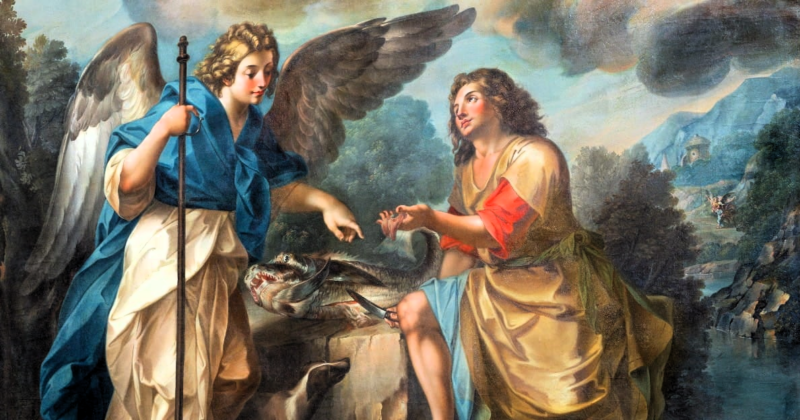
The narrative of the Book of Tobit revolves around the story of two Jewish families exiled among the nations, yet remaining faithful to the traditions of their ancestors, despite many obstacles. Raphael enters into the heart of these two families as a representative of God and assists them in the most delicate moments of their story. He appears in the form of a man who accompanies Tobias, whom his father Tobit sends to recover some money from a relative after the family falls into poverty due to Tobit’s blindness. On their journey, they catch a fish from the river Tigris after it tries to attack Tobias’ leg, and Raphael instructs him to open the fish and remove its gall, heart, and liver, as they will find good use for them.

During this journey, Raphael guides the young man to find his future wife, Sarah, and through the burning of the fish’s heart and liver on their wedding night, she is freed from an evil spirit that had killed every man who married her and approached her. After retrieving his father’s money, Tobias returns home with his wife, and, through the fish’s gall, God heals Tobit’s blindness.

It is at the end of these events that Tobias’ companion on the journey reveals his true identity: “I am Raphael, one of the seven holy angels who present the prayers of the saints and enter into the presence of the glory of the Holy One … Do not be afraid; you will be safe. But praise God for ever. I did not come as a favour on my part, but by the will of our God. Therefore praise him for ever” (see Tob 12:15–18). As soon as he said this, Raphael ascended and disappeared from their sight.

On the journey of life, you probably won’t encounter any fish trying to bite you. But you’ll certainly come across two-legged sharks, and you’ll experience no shortage of trouble from evil. So, it’s not a bad idea to pray to Raphael the Archangel, asking him to accompany you along your way and to bring healing of heart to you and, through you, to others.

Why Celebrate the Cross?

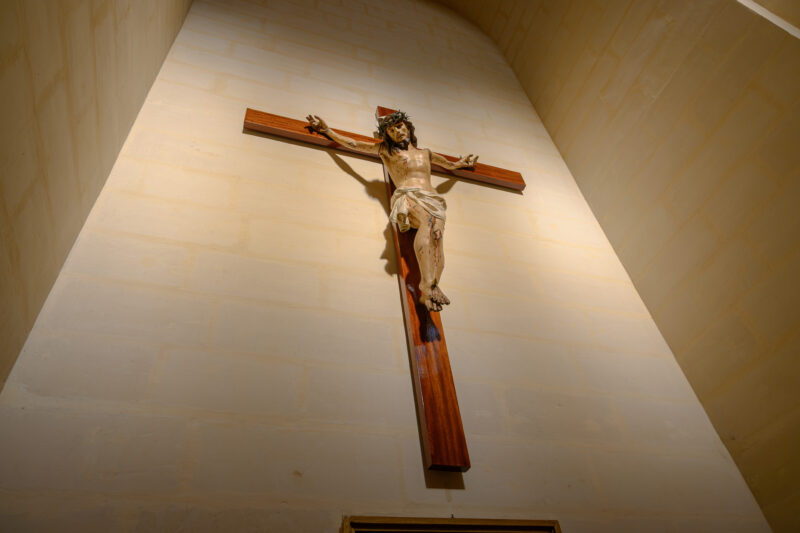
On 14 of September, the Church celebrates the feast of the Exaltation of the Holy Cross. But why celebrate the Cross? We certainly don’t usually see the crosses of life as occasions for joy or merrymaking. So what meaning does this feast’s joy really hold? How can the Church rejoice in the Cross and even greet it as her only hope — Ave Crux, spes unica?

Although previously a separate festivity—The Invention of the Holy Cross on 3 May—in this feast the Church also commemorates the finding of the Cross. When we discover a new cross in our lives, whether through illness or some other trial, Christ, through the “foolishness of the Cross,” calls us to something deeper. In recognising our inability to make sense of life’s crosses, He offers us the grace of heavenly wisdom. This wisdom does not illuminate the entire path at once, but lights up the next step—just enough to keep us moving forward, step by step, until one day, when we look back, we recognise the marvellous work of God’s providence in our lives.

On this day, the Church also remembers the consecration of the first Basilica of the Holy Sepulchre in Jerusalem, which includes both the tomb and Golgotha. This took place on 13 September 335. A consecration is always a cause for joy. But it also implies separation and setting apart: when we consecrate an altar, a place, or persons, we dedicate them wholly and exclusively to God’s service. In baptism, we were all consecrated as temples of the Holy Spirit. This consecration sets us apart from others and at times may even isolate us. Yet, it also brings us into the greater family of God’s children, united with Jesus, our elder brother. And this is truly a source of joy, because it means we are not—and do not have to be—alone in carrying our crosses.

In the Church, like Simon of Cyrene, we help one another carry life’s crosses. We stand under each other’s crosses like Mary stood beneath the Cross of her Son, and, like the Veronica, we wipe the faces of our suffering brothers and sisters with the tenderness and comfort we can offer—even if we ourselves are crushed under our own burdens. In fact, it may be precisely because we are also weighed down but haven’t lost hope that we can truly offer consolation and strength to others.

Finally, the Church commemorates the victory of the Cross, for on 14 September 629, a large relic of the True Cross was raised once again in the Cathedral of Hagia Sophia in Constantinople, following its recovery by the Byzantine Emperor Heraclius, who reclaimed it from the Persians fifteen years after they had seized it and taken control of Jerusalem. We do not rejoice before the Cross just as we don’t get the same feeling that we had been on holiday when someone brings us a souvenir from a place he or she visited. The Cross is no pretty keepsake, and far less so its relics. Yet we rejoice in a way similar to the gratefulness and joy we feel when someone thought of us and brought us a souvenir, especially if they were on a pilgrimage to a holy place and prayed for us. We rejoice just as we rejoice in something precious returned to us after it had been lost or stolen.

Of course, we wouldn’t cry if we were relieved of some burden or cross in life. But the saints actually prayed to have a share in Christ’s Cross, because they understood that only in this way could they also share in His glory. They grasped what St Paul wrote to the Colossians: “I rejoice in my sufferings for your sake, and in my flesh I complete what is lacking in Christ’s afflictions for the sake of his body, that is, the Church” (Col 1:24). In the redemption wrought on the Cross, Christ has left a small portion for each of us to freely choose whether we wish to be part of this hope for the world or remain trapped in our own selfishness.

Undoubtedly, all this is a paradoxical kind of joy—if not outright contradictory by the world’s logic. But as St Paul wrote to the Corinthians: “the foolishness of God is wiser than men, and the weakness of God is stronger than men” (1 Cor 1:25). And Paul goes on to challenge them—and us—to consider our own position in light of this truth (see 1 Cor 1:26a). This feast, too, challenges us to reflect on where we stand before the Cross.

And now that you know why this feast is truly a reason for joy, what will you choose? Will you continue to let the crosses of life rob you of joy and hope because you resist trusting, even if you do not understand? Or will you allow joy and hope to open your arms wide, so that the Cross may embrace you and allow the One who is the most beautiful among the children of men to visit you and kiss you with His gentleness (see Ps 45:3; Song 1:2)? Never forget: even He did not choose the easy road: He descended to the deepest depths to lift you up to His heights.

Which siege must we fight today?

The convoy entered the Grand Harbour, but the siege is still ongoing. This time, it’s no longer against the Ottomans who sought to rid themselves of the Order of St John’s interference in their struggle for control of the Mediterranean, nor against the Axis who had the same objective. Nor is it against the French, trapped behind the fortifications built by our forefathers—so strong that not even their descendants could breach them.

Could it be that the convoy of values we asked Mary to bring us is beginning to arrive and be unloaded? Or has it ended up like the countless trucks loaded with food aid blocked from reaching the starving population of Gaza?

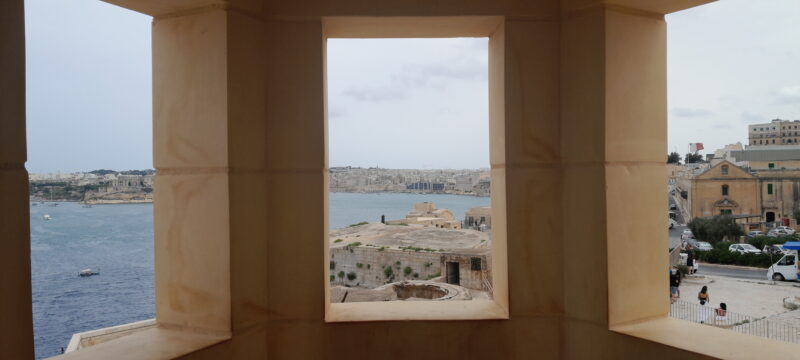
With my gaze fixed on the Grand Harbour, where so many events that shaped our country’s history unfolded, I find myself asking: who is the enemy besieging us today? From which siege do we hope Mary will deliver us and grant us victory? The aims and enemies of the past sieges I’ve mentioned were clear—we knew who they were and what they wanted. But who is the enemy today?

We Maltese are nothing without pika; it seems we cannot exist without an adversary, be it in politics, village festas, football or regatta, or rivalry with the neighbouring town or even our own neighbours within the same street or apartment block. And our island mentality often leads us to see threats and enemies everywhere.

We seem to need a siege—or at the very least, we feel surrounded. If nothing else, besieged by the sea, the salt, and the wind that erode our rocks and deposits the particles elsewhere, while other sediments arrive from afar, settling on our shores and leaving their mark … We are caught in a constant cycle of weathering and rebuilding sometimes in ways that may rob us of our identity and construct a new one, turning us into carbon copies of other nations. But we are Maltese!

So, what is the siege that threatens our identity? Could it be the siege on our faith and religion? If we’re honest with ourselves, we must admit that the greatest threat to our faith comes from within—from us forgetting what we truly believe in and who we truly are. That makes it easy to be swept along by the currents of the West or to fear the waves from the East and the southern winds from Africa…

Or, perhaps, it is the airstrike on the dignity of every human being, regardless of origin, gender, physical ability, social status, or beliefs? This remains as real today as it was in the concentration camps. And, through the media, we are witnessing in real time almost a replica of it. But within our shores, the enemy does not necessarily come from outside. Sometimes, we are the ones inflicting it upon our own people.

Isn’t it ironic that, from being a colony, we’ve adopted a colonial mindset—one that exploits from the comfort of our own homes? Pause for a moment and consider: where does the food you eat come from, the clothes you wear, or all the services you rely on when you can’t be bothered to move from the sofa? Then it becomes clear. Might Mary need to protect those who are suffering because of us—for whom we are the threat?

The greatest battles are fought on the walls of our hearts and minds. On one side, we need to be challenged by the Word of God; on the other, we are being attacked by ideologies that threaten our integrity, goodness, and authenticity. The consumption of advertised genuine Maltese products does not make us any more genuine or more Maltese. There are walls of pride and mistrust that need to be breached, and others we must be prepared to stand upon and fight to the last drop of blood, if necessary, so that no one who lives on these rocks is exploited, silenced, manipulated, or controlled in the expression of one’s faith, as if the practice of one’s beliefs could offend another’s, or as if preserving our culture can only happen by eliminating every other.

This rock at the crossroads of civilisations has certainly seen many sieges and enemy attacks, but it has also witnessed years of peace, during which pagans, Christians, Jews, and Muslims lived and worked together for the progress of all. And our Lady is not of sieges, but of Victories. If we turn to her, she will surely help us overcome our self-centredness, look into the mirror and see who we truly are, remind us of who we are called to be, and help us see the other as our brother—sharing in our common humanity—before we charge into battle once again.

Why all those cloths on the altar?!

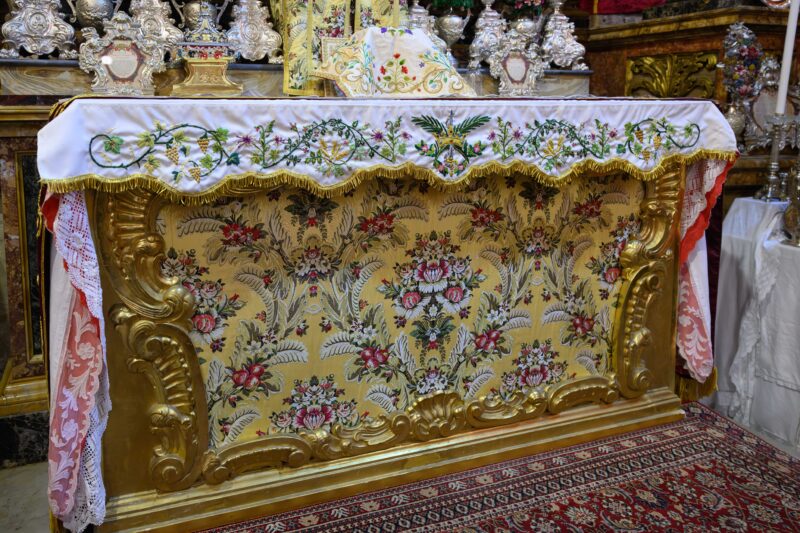
A few weeks ago, we spoke about the altar cards that are displayed on the altar during the feast days in our churches. But there are other things that we might find odd or not quite understand. Among these are the cloths that cover the altars because there’s not just one or two of them, but four! These cloths often feature fine Maltese lace along the edges—as if one cloth is trying to outdo the other—or the most delicate embroidery, as is fitting for the ‘table’ upon which the Eucharist is celebrated. But exactly why is all this laid out?

The General Instruction of the Roman Missal stresses that the only altar to be adorned and decorated should be the one on which the Mass is being celebrated, precisely because the altar itself is a symbol of Christ, who “for our salvation, showed himself the Priest, the Altar, and the Lamb of sacrifice” (see Preface V of Easter). Although other altars were not need to be removed, they should not be specially decorated in a way that distracts the faithful from this one focal point (see par. 303). Nevertheless, in our country, the tradition of decorating all altars has been maintained, according to the norms prior to the liturgical reforms of Vatican Council II when there was a more ‘private’ understanding of the Mass.

Even though today this may appear simply as decoration, these side altars were once also in use—sometimes with masses celebrated simultaneously in the same church. Those who are older may remember how some parishioners would move from one altar to another—even if they had already started hearing Mass—when the bell signalled a priest they preferred, or one who celebrated Mass more quickly, emerging from the sacristy! Liturgical norms may change, but it’s not quite so easy to change the mindset of a people …

Where side altars continue to be decorated, it’s likely that this is still being done in accordance with older liturgical norms which prescribed that, on an altar where the Eucharist was to be celebrated, three linen cloths made of pure linen were to be laid, and sometimes a fourth cloth covering just the altar stone would be added. These cloths symbolise the linen shroud in which Christ was wrapped when He was taken down from the cross and laid in the tomb, as we are told in the Gospel of John (19:40). The use of the three altar cloths probably dates back to the ninth century and had a practical purpose: to absorb the Blood of Christ in case it was accidental spilled.

When Mass is not being celebrated, the altar would be covered with what is known as the sopra terħa (literally, top cloth), to protect it from dust while not in use—thus referred to as vesperal cloth. During feast days, the sopra terħa is generally made of red velvet with gold embroidery, but in ordinary times, it used to be of a green colour and made of a simpler material. If we stretch the symbolic meaning a bit further, we could liken the sopra terħa to the scarlet robe that the Roman soldiers placed on Jesus while they mocked Him—which, according to the Synoptic Gospels, was taken off before Jesus was taken to be crucified. In the same way, the vesperal cloth is removed for the celebration of Mass, where Christ once again makes Himself present and offers us a share in His sacrifice, which was made once and for all on Calvary (see Hebrews 7:27).