

Author: Rev Gilbert Scicluna

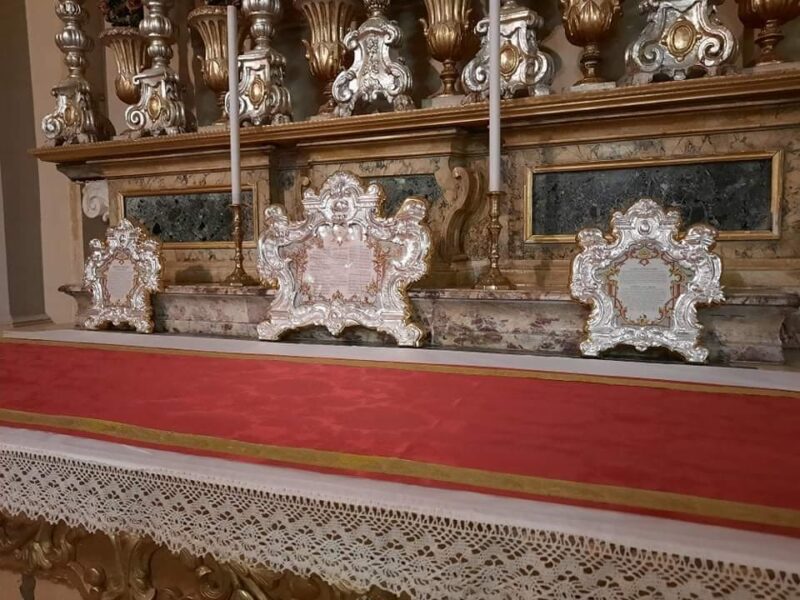
Why do we place three oddly shaped frames on the altars during the festa?

As we are well into the feasts’ season, we see furnishings, decorations, and liturgical objects of immense value and inestimable worth in our churches. Some of these are purely decorative—like, for example, the red damask hanging on the walls. But other objects serve a practical purpose, such as the candlesticks on the altar, the chasubles, and the chalices. Some of these remind us of priests to whom they once belonged and who left them for the use of the parish. We also remember people who used to care for these same furnishings or who were their benefactors. While there were certainly wealthy benefactors, there were also generous donations from large, low-income families who were willing to make even further sacrifices so that the Lord’s house is adorned with the finest materials and artifacts for the celebration of the sacred mysteries.

Then there are objects we have grown used to but rarely consider their meaning—like the canopy, whose purpose is to honour and cover, in regal fashion, the most sacred spaces: the altar and the tabernacle. Yet, there are other objects that we have either lost or forgotten their purpose—particularly because they have continued to be put on display in our churches, even though they lost their purpose following the liturgical reforms of the Second Vatican Council.

Perhaps the most prominent among these are three somewhat oddly shaped frames—one larger than the other two—which are set up on the side altars. These are usually made of silver, or wood coated in silver, or another shiny metal, with glass covering a sheet of yellowed paper adorned with delicate decorations and inscriptions. I’m referring to the Altar Cards, which are called “Karti Glorja” (Gloria Cards) in Maltese. But why do we call them this? What was their purpose?

Before the liturgical reform, priests would celebrate Mass privately at the various altars of the church, sometimes simultaneously. Apart from the missal—which is the book containing the prayers of the Mass—these three framed cards were also placed on the altars, each containing different parts of the Mass. On the left-hand side was placed the card with a passage from the Prologue of the Gospel according to John (Jn 1:1–14), which was recited at the end of the Mass. In the centre stood the larger altar card, which contained, among other things, the Gloria (hence the name), the prayer said silently by the priest before the Gospel, the Creed, the words of consecration and other parts of the Eucharistic Prayer. The third card, on the right, included the prayer said by the priest as he poured a few drops of water into the chalice filled with wine during the offertory, and the prayer said during the washing of the hands—taken from Psalm 26, beginning with the words: “I wash my hands in innocence, and go about thy altar, O Lord,” (Psalm 26:6).

The priest was expected to know these prayers by heart, and so the Karti Glorja served as a reminder. Even the placement of the cards on the altar reflects the location from which the priest would say that particular prayer. For instance, the words of consecration are found on the centre card, while the prayers from the offertory is on the left, where the priest would stand to fill the chalice and where the server would wash his hands.

I hope that now I’ve satisfied your curiosity about those blessed strange yet beautiful frames. When you walk into a church during feast days, you’ll be able to better appreciate not only the genuine devotion of our ancestors, who wanted to offer only the best to God, but also the understanding that everything in the liturgy has a purpose—not simply to embellish, but to reflect the beauty of the mystery being celebrated.
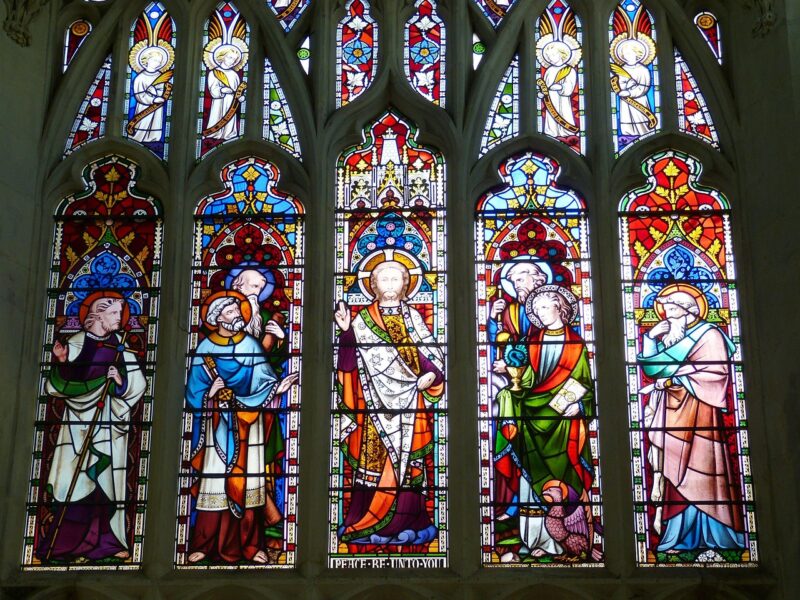
What does it mean to be an apostle?

As we find ourselves between the Solemnity of Saints Peter and Paul, the Feast of the Apostle Thomas, and the Gospel reading for the Fourteenth Sunday in Ordinary Time (Year C)—where Jesus sends out the seventy-two disciples two by two to every place he intended to visit—we are naturally drawn to reflect on the apostolate. Again and again, we see the Lord choosing people not to remain idle, but to be sent.

The very word apostle comes from the Greek verb apostelló (ἀποστέλλω), which means “to send away” or “to dispatch on a mission.” It suggests movement, purpose, and being entrusted with something beyond oneself. In the New Testament, the term apostle does not only apply to the Twelve—the closest companions of Jesus whom the Evangelists often refer to simply as “the Twelve.” Rather, apostles were those who were sent by a living community of faith, usually in pairs, to proclaim and share the life they themselves had received in Christ.

This missionary identity did not end with the first generation of believers. Through the gift of the Holy Spirit received in the Sacrament of Confirmation, each of us is called to participate in this apostolic mission. The call to be apostles—heralds, witnesses, and ambassadors of the Gospel—is embedded in our Christian identity. For how could the joy of encountering Christ leave us satisfied with private devotion alone?

While not every Christian is an apostle in the formal sense of being specially chosen and sent, all of us are called to be living witnesses. Through what we think, say, and do, we prepare hearts to receive Christ and bring his peace into the world. According to our own place in the Church and in society, we are each sent—not to stand still, but to go forth with the Gospel.


Why is the Pope’s ring called the Ring of the Fisherman?

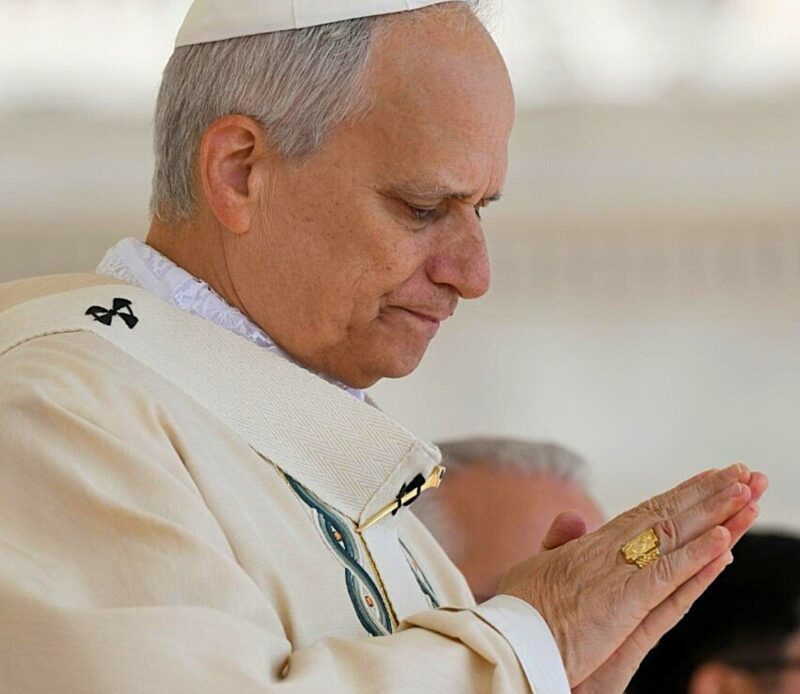
I don’t know whether you noticed like I have that, during the Mass at the Beginning of the Petrine Ministry, and also on various other occasions, Pope Leo XIV often finds himself gazing at the ring that was placed on his finger by Cardinal Tagle, representing the cardinal bishops. It’s as if, on one hand, he feels the weight of the responsibility entrusted to him by the College of Cardinals, and, on the other hand, his deep gaze seems to reach far beyond. Then he gives a slight turn of his shoulders, as if he’s finding his place beneath the yoke.

Since the 6th century, it seems it was already customary for bishops to be given a ring that expresses their bond with the local church entrusted to them — as though she were their bride. Over the centuries, this ring also developed to become the seal with which a bishop would authenticate official documents. The same applied to the pope’s ring until 1842.

However, the ring with which the pope is invested is not an imperial ring. It is called the Ring of the Fisherman because, before any temporal or civil authority he may hold, the pope is the successor of the Apostle Peter, the Fisherman. And I dare say that this ring somehow gathers up the entire mystery behind Pope Leo XIV’s gaze … and, ultimately, the mystery of every vocation.

In fact, before the ring is placed on his finger, the Cardinal Bishop says these words:

Most Holy Father, may Christ, the Son of the living God, the pastor and overseer of our souls, who built his Church upon rock, grant you the Ring, the seal of Peter the Fisherman, who put his hope in him on the sea of Galilee, and to whom the Lord Jesus entrusted the keys of the Kingdom of Heaven.

Today you succeed the Blessed Apostle Peter as Bishop of this Church, which presides over the unity of charity, as the blessed Apostle Paul has taught; may the Spirit of charity, poured into our hearts, grant strength and gentleness to your ministry to preserve all those who believe in Christ in the communion of unity.

And, truly, in that moment, the Shepherd-Fisherman successor of Peter, like that Apostle who responded to his first calling in his youth, is now girded with the garment of a shepherd. And, for the confession of his love, the Lord gently commands him to follow him, because only by following him can he truly be faithful in leading the people to Christ, who is the Way, the Truth, and the Life.

The Crozier: The Shepherd’s Staff

Another symbol associated with the Papal and Episcopal liturgy is the crozier. This symbol too signifies the responsibility of the shepherd. The origin of the use of the crozier in the Church is not entirely clear, although the use of some form of staff or rod was quite common both in religious and in civil and political contexts. For example, priests in various Roman pagan rites used the lituus, a ritual wand in a curved shape.

However, in the case of the crozier, the meaning goes beyond a simple sign of power—it is a symbol of authority and responsibility rooted in that of the Good Shepherd, and of God as the Shepherd of Israel. In fact, in Psalm 23 we find how God shepherds and comforts through the shepherd’s staff, even when life leads us through the valley of the shadow of death:
“thy rod and thy staff, they comfort me” (Psalm 23:4).

The staff is also a symbol of God’s authority entrusted to humans, such as the staff of Moses with which he led the people out of the land of slavery into the Promised Land. It is not by chance that in some Eastern churches, a ferula or a crozier with serpents on the top is used, referencing the bronze serpent that Moses lifted high so the children of Israel could look at it and be saved (Numbers 21:4–9).

It seems that some form of crozier or pastoral staff was already in use by bishops as early as the fifth century. The Western-style crozier has the shape of a staff with a curled top so that the shepherd can draw in the sheep and keep them on the path. According to Saint Isidore of Seville, writing two centuries later, the crozier is given to the bishop during his consecration as a sign of the responsibility to lead and correct, while also supporting the weakness of the sick (De Ecclesiasticis Officiis 2.5.12, PL 83.783C–784A).

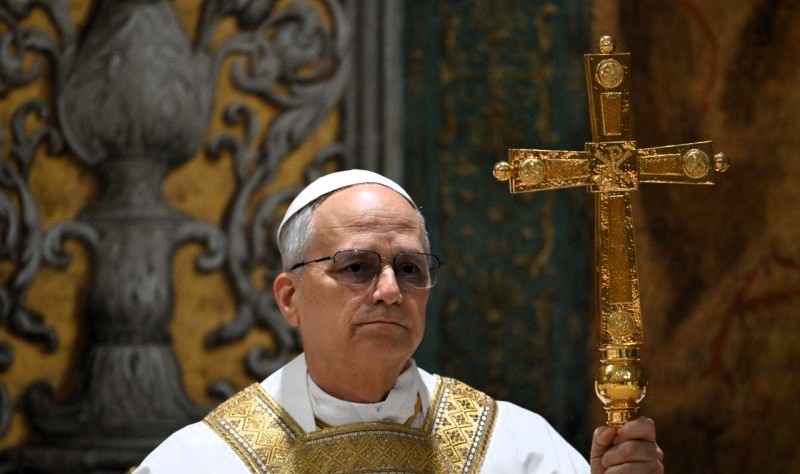
However, the curl at the top may also be a sign of the bishop’s limited authority over his own territory. This is why the pope does not—and still does not—use a regular crozier. Instead, at the top, there is a crucifix, because his responsibility is for the entire flock of Christ spread throughout the world. In earlier times, a ferula and even a crozier were used, although for the reason just mentioned, they eventually fell out of use. When the use of a form of staff was reintroduced for the pope, it still differed from that of bishops, as it featured the papal cross with three crossbars—the same symbol used on churches that have a special connection with Rome, such as basilicas.

This universal responsibility and leadership is powerfully expressed if we imagine the Pope as a shepherd walking ahead of the flock, following the cross he carries in his left hand, which touches the ground in front of him. In this way, the cross is always one step ahead—because even the Pope is a disciple. It is no coincidence that in his homily on the Fourth Sunday of Easter, while celebrating Mass in the crypt of St Peter’s Basilica, he says:

While we celebrate the beginning of this new mission of the ministry that the Church has called me to, there is no better example than Jesus Christ himself, to whom we give our lives and whom we depend on. Jesus Christ whom we follow, he is the Good Shepherd, and he is the one who gives us life: the way and the truth and the life.

Leo XIV, Homily, 11 May 2025

The Good Shepherd and the Pallium on the Pope’s Shoulders

The Fourth Sunday of Easter is characterised by the image of the shepherd. Although they formed part of the lowest ranks of society, even in the Old Testament we already find the association between the shepherd and his care for the flock with God and His love for the chosen people. In these days, which are so important for the Church due to the selection of Peter’s successor, there are two symbols that specifically highlight the Pope’s role as the shepherd chosen by Christ to guide His flock. These are the pallium and the pastoral staff.

In this article, we begin with the pallium. The pallium is a type of stole or scarf made from lamb’s wool, bearing six small black crosses. It is worn over the shoulders and on top of the chasuble. The exact origin of this pontifical vestment is unclear, but it appears to have been in use by the fourth century and seems to share the same roots as the omophorion used in the Eastern Churches. However, due to its particular shape, the pallium took on a pastoral significance as it visibly resembles the traditional iconography of the Good Shepherd carrying the lost sheep on his shoulders, around his neck.

In the East, the omophorion is worn by all bishops and has a slightly different form. In the West, the pallium was originally a papal privilege, but its use was later extended to all archbishops to signify their authority of metropolitan bishops as a participating in the authority and mandate of the successor of Peter, whom Christ commanded to “feed my sheep” (see John 21:15–19). Regarding the omophorion, Saint Isidore of Pelusium in one of his letters (Epistolarum Liber 1.136, PG 78.272C) draws the analogy between the wool material and the lost sheep that the shepherd in the parable from Luke lifts onto his shoulders when he finds it (Luke 15:5).

Each year, on the feast of Saint Agnes, 21 January, at the Basilica of Saint Agnes Outside the Walls, the Trappist monks of the Monastery of the Three Fountains present two lambs that are blessed and entrusted to the Benedictine Sisters of Saint Cecilia in Trastevere. Before Easter, the lambs are shorn so that their wool can be woven into the palliums, which are then placed on the tomb of the Apostle Saint Peter on June 28. The next day, the Solemnity of Saints Peter and Paul, they are blessed by the pope and handed to the present archbishops. The imposition of the pallium takes place in the archdiocese by the Apostolic Nuncio.

As we contemplate this image of the Good Shepherd—or, rather, the Beautiful Shepherd—let us pray together with the Church that the shepherd given to her by the Lord may truly please Him in holiness and never cease to care and watch over her good and unity.

Why we commit no sin in eating Carob Caramels?

If we Maltese are not renowned for anything, surely no one will beat us to trying to find a way around everything … including the rules of fasting and abstinence during Lent! The most important thing is not to sin, even if we try to fool ourselves—because, of course, it’s a little too much to pretend to be capable of fooling God. No wonder one of our Lenten sayings is: “Karamelli tal-ħarrub, min jikolhom ma jagħmilx dnub”—carob caramels, whoever eats them commits no sin!

In the past, these small squarish caramels were made using carob syrup. Today they are sometimes made from caramelised sugar. But why do we sat that whoever eats them commit no sin, even on days of abstinence? Contrary to popular belief, the law of abstinence only prohibits the eating of meat. Nothing is said about sweets and sugar.

The same applies for the kwareżimal, which is a sort of Lenten sweetmeat. Before the Apostolic Constitution Paenitemini of Pope Saint Paul VI, the law of abstinence not only excluded meat, but also other animal products, such as eggs, dairy products, or animal fat, could not be consumed. Today, we would say that a vegan diet had to be followed! The kwareżimal still offered something delicious without using any of the forbidden products, because the ingredients are ground almonds mixed with flour, a few cinnamon flakes, and a little rose water and honey.

Even carob caramels do not contain any of these prohibited products. That’s why we say that there’s no sin in eating carob caramels—although I doubt whether dentists share the same opinion…

Perhaps certain rules seem no longer relevant or meaningful. At the same time, contenting ourselves by just not committing sins is not a sign of true faith. What a pity it would be if we settle for little and don’t strive to move on and recognize in fasting and abstinence a possibility to cultivate in us a dependence on God alone. Sweets and meat—and many other things—are not indispensable. But we cannot do without Him!

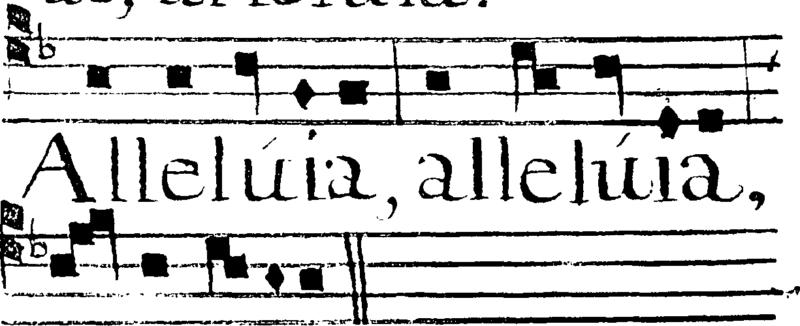
Don’t sing the Alleluia during Lent!

Have you ever noticed that during Lent we don’t sing the Alleluia at Mass, but instead we say, “Glory and Praise to you, Lord Jesus Christ” or some other similar formula? Lent is a very important season in the Liturgical calendar because it serves as a preparation for the celebration of the Paschal Mysteries, and it is also a penitential season that helps us acknowledge our sins and give God the first place in our lives. The three words that characterise this period are: prayer, fasting and almsgiving. But what does the word Alleluia have to do with this?

During this time, Christians fast, so to speak, from saying Alleluia, which comes from the Hebrew words hallalu, that means ‘praise’, and yah, which is a short form of the name ‘Yahweh’, God’s Name. In short, the word Alleluia means ‘praise God’. This is a joyous acclamation through which we are reminded that during Mass we are united with the choirs of angels to celebrate the Kingdom of God even while we are still in this world.

But during Lent we focus on the need to prepare ourselves to receive salvation and the Kingdom of God. The forty days of Lent remind us of the forty years that the Israelites spent in the desert. It is a time of reflection and purification, that urges us to long for the salvation that God offers us through the Paschal Mystery, meaning the Passion, Death and Resurrection of Christ.

The ‘fast’ from singing the Alleluia is one of a number of small changes in the Liturgy that emphasis the penitential character of this season, amongst which is the Gloria, in which there is found the joyous news of the angels who proclaimed the birth of Jesus; the Responsorial Psalm is taken from the penitential psalms or from other psalms that ask God to intervene in moments of trial; flowers are not placed on the altar; and the liturgical colour is purple, which, as explained earlier, symbolises penance and repentance. These changes help us focus our attention on repentance and uniting ourselves to God’s will through penance and prayer.

Thus, this ‘fast’ from singing the Alleluia serves to prepare us, and creates an internal longing to celebrate Easter with the hope of one day adoring and praising God face to face in Heaven where we will join in the never ending Alleluia.

Stop and Think:

Praising God is an almost forgotten form of prayer. Maybe it is because we are used to praying to God in times of need. How long has it been since you have praised God for all the graces he has given you in life?

In what ways can you better prepare yourself to sing the Alleluia on Easter Sunday with a pure heart?

St Teresa of Avila: “God alone suffices”

On 15 October, the Church commemorates St Teresa of Avila, Virgin and Doctor of the Church. She laboured together with St John of the Cross in reforming the Carmelite Order, which led to the founding of the Discalced Carmelite Order, also known as the Teresians.

Born in the Spanish city of Avila in 1515, she had flowing in her veins the blood of the warrior women of this city. Approximately two centuries before her birth, when Avila was threatened by the attacking Moors, the city’s soldiers advanced with the aim of keeping the enemy army away from the city. But the enemy was waiting for this occasion in order to attack the city when there was no one to defend it. When faced with this threat, Jimena Blazquez, the mayor’s wife, organised the women of the city, and, dressed in armour, they all went and stood on the bastions of the city. In this way they managed to deceive the enemy who thought that the city still had enough soldiers to defend it.

This spirit of a warrior is reflected in her writings, as well as in the courage she displayed when confronted by obstacles in her holy pursuit to reawaken the spirit of Elijah in the Carmelite Order. Even her imagery of the interior castle mirrors the city of Avila, which no one was able to lay siege to or capture.

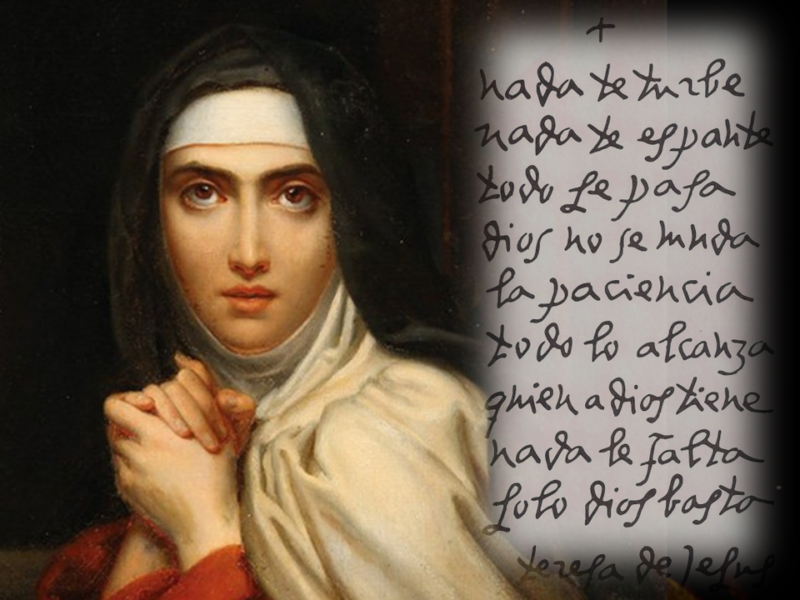
What characterises this treasury of wisdom and prayer, is a bookmark found in her prayer book after her death in 1582. On it was written a meditation about trust in God, which reads as follows:

Let nothing disturb you,
Let nothing frighten you,
All things are passing away.
God never changes.
Patience obtains all things.
Whoever has God lacks nothing;
God alone suffices.

We can say that within these few verses, we find what forms the heart of this warrior who recognised that, without her beloved, she could not engage in any battle. She was able to arrive at this strength and courage because she recognised that her refuge was in God who alone suffices. This certainty resembles the powerful declaration made by Christ in his eschatological discourse: “Heaven and earth will pass away, but my words will not pass away” (Mt 24:35).

In a letter sent to the Bishop of Avila, on the occasion of the 450th anniversary of the beginning of the Teresian reform, Pope Benedict XVI makes an invitation that is also relevant to us, for all times and in all circumstances:

Following in the footsteps of Teresa of Jesus, allow me to say to all who have their future before them: may you too, aspire to belong totally to Jesus, only to Jesus and always to Jesus. Do not be afraid to say to Our Lord, as she did, “I am yours; I was born for you, what do you want to do with me?” (Poem 2). And I ask him to obtain that you may also be able to respond to his call, illuminated by divine grace with “determined resolve” in order to offer “that little” which is in you, trusting in the fact that God never abandons those who leave everything for his glory (see The Way of Perfection 21, 2; 1, 2).

Benedict XVI, Letter to the Bishop of Avila on the occasion of the 450th year since the foundation of the Monastery of St Joseph in Avila and the beginning of the Carmelite reform (16 July 2012), par. 5.

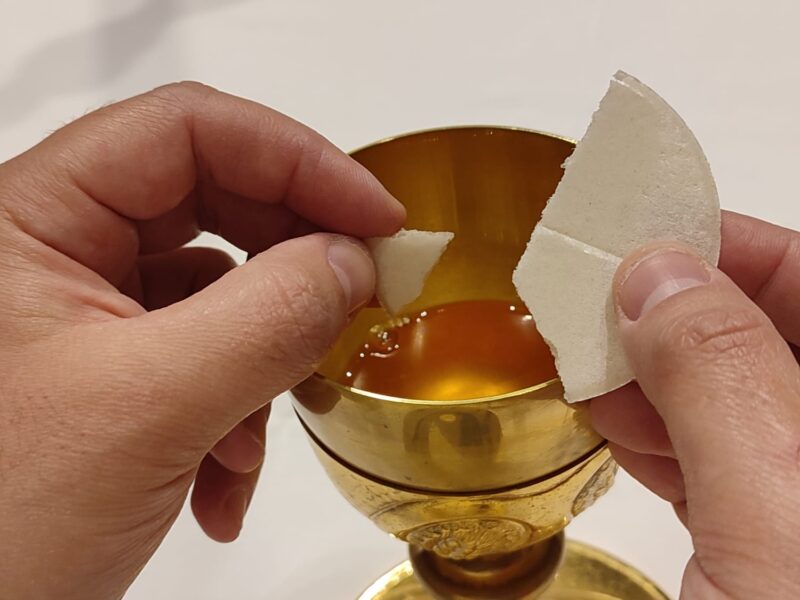
Why does the Priest break a piece of the Host and place it in the Chalice?

Have you ever noticed that during Mass, before communion, the priest breaks of the Host and places it in the Chalice? It is important to keep in mind that in Eucharistic celebrations words and actions are not there by chance; but all have a specific purpose that have continued to develop with the passage of time in the traditions of the Church. So, what does this action mean?

In St Paul’s letters, as well as in the Acts of the Apostles, we find that the Apostles celebrated the Paschal Mystery as commanded by Jesus by the breaking of bread (Acts 2:46; 1 Cor 10:16). Furthermore, in Luke’s Gospel, we find the disciples of Emmaus recognising Jesus in the breaking of bread (Lk 24: 35). This action during the celebration of the Mass reminds us of the last supper when Jesus, with boundless love, just before dying for us on the Cross, gave himself to us in the Eucharist. The breaking of the bread symbolises the unity of those partaking from the same bread as well as Jesus’ sacrificial act when he gave himself for us completely on the Cross.

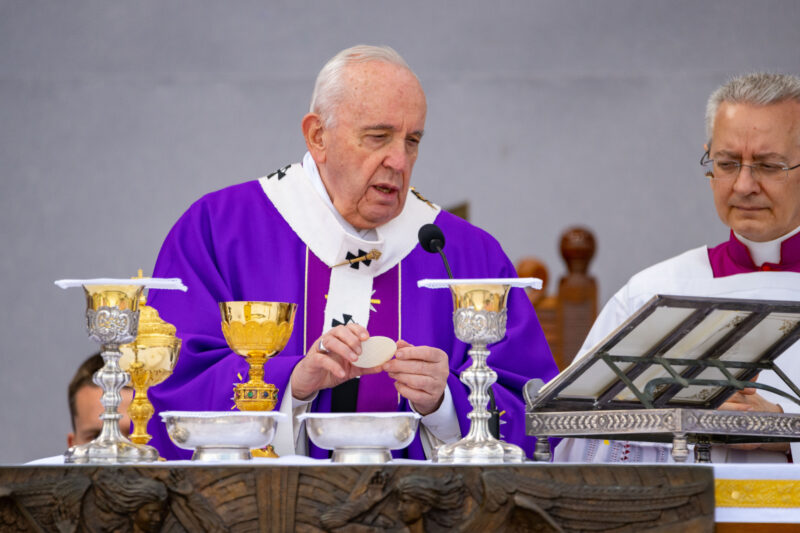
The priest not only breaks the Host, but after the sign of peace he takes the host in his hands, breaks it on the paten, and places a small piece of the Host in the Chalice, while silently praying:

May this mingling of the Body and Blood
of our Lord Jesus Christ
bring eternal life to us who receive it.

The small piece from the Host placed in the Chalice is called fermentum, a Latin word that means ‘yeast’.

Originally, the fermentum was a sign of Christian unity because in the early Church the Bishop of Rome concelebrated mass with the priests. Then on Sunday they would celebrate mass in their titular churches. Therefore, the Pope used to send to the surrounding churches pieces of the consecrated host, consecrated during the Mass concelebrated with the priests. We find that in the fourth century, the Council of Laodicea restricted this practice, although in the writings of Pope Innocent I (402-417) we find that the tradition of the fermentum was still present. There are some liturgical historians who also claim that, for a brief period, the priest would place two pieces of the Host in the Chalice, one piece from the Mass concelebrated with the Pope or from the local Bishop, and another piece from a Mass the same priest had previously celebrated. This last piece was placed in the Chalice to symbolise the unity between every Mass.

When this tradition was no longer observed, the priests still continued to place a piece of the Host in the Chalice. Therefore, this action, when seen in its context, demonstrates the unity between the Christian faithful and the visible shepherds of the Church: the Pope together with the bishops.

Stop and Reflect

  • Are my prayers mostly focused on my needs? Do I see myself as a member of the Body of Christ?
  • How often do I pray for the bishops and the Pope?

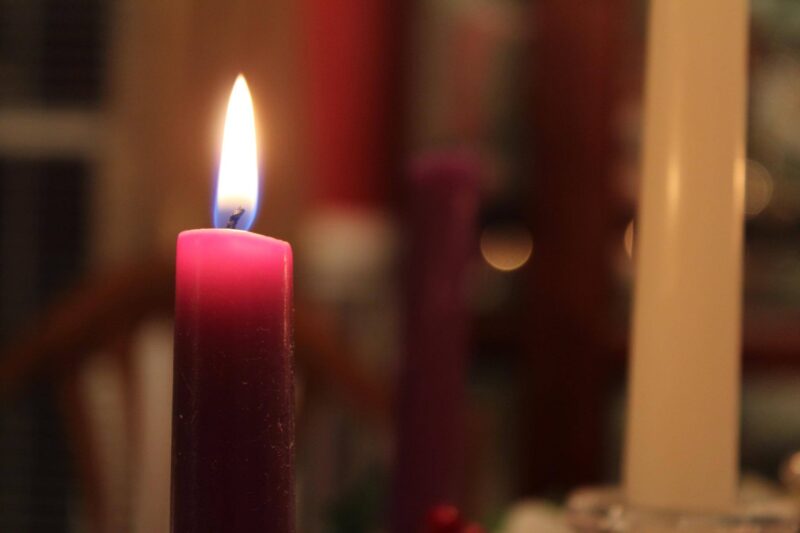
The Candles on the Advent Wreath

In Maltese there is a saying which goes: “Darbtejn insiru tfal!” (we become children twice!) But I would dare to say that during this month we all become children again, or at least our eyes light up with true and innocent joy. It is true that the wreath used at church is blessed with solemn prayers, but, speaking for myself, I look forward each year for the blessing of advent wreaths with four candles—three purple and one rose—that the children are invited to bring with them. You cannot help smiling seeing children carrying wreaths larger them themselves! You cannot help admiring them who out of recycled or craft materials make their own wreath! The best part is when the candles start falling off or breaking in two before they are taken back home to become a visual symbol of Advent as an anticipation of Christmas rather than merely four weeks full of events and never-ending parties.

The sad thing is when you realise that the wreath used is the same one from last year … because it was brought out to be blessed and maybe used as a decoration at home. But let’s be honest: how can twinkling lights take the place of a natural flame, that slowly melts the wax as a symbol of the constant passing of time? Even in our churches, how can we, out of pragmatism, avoid the flame tunnelling the candle by using tubes filled with candle oil in different sizes, ranging from the shortest to the tallest.

This might sound a little sentimental, and undeniably it is so. But if liturgy and faith are emptied of emotions, gestures and symbols that have a deeply profound meaning, everything we do simply becomes an exhibition and a pantomime to demonstrate that we too can achieve what others can. After all, for many, what counts is posting pictures on social media or turn to sensational gimmicks that turn faith into something superficial, like the icing on a cake, that many remove because it makes them nauseous due to its sweetness. And each year we are so fussy on blowing out the candles on our birthday cake, but it’s a scandal to light a candle before a holy image because it is judged as idolatrous—as if the celebration of our birthdays isn’t a form of idolatry of the ‘I’.

A candle is a prayer that remains before God, Our Lady and the Saints who are in heaven, even after we leave the church and again face the trials of life. A candle is a prayer that flickers in the breeze that comes through the open doors of our churches. A candle dispels the darkness even if you can only see a few metres ahead of you. A candle melts until it burns out completely. And, when it burns out, it is thrown away, but its work has been done, it has accomplished its mission.

We are candles. We are not artificial lights, perfect and reusable. Nor are we oil lamps that do not emit soot. We are candles, that light up and are blown out, that struggle with the currents to remain lit in the wind and cold. We are candles that warm the cold hands in which they rest. We are candles that burnout. Apart from the colour, shape and size what distinguishes us is simple: on which altar will you choose to give your life?