

Author: Rev Gilbert Scicluna

They departed to their own country by another way

The latest date on which the Feast of the Epiphany can occur is 8 January. In this case the Feast of the Baptism of Our Lord is celebrated on the following day, which is Monday, instead of on a Sunday. Suddenly, we find ourselves in Ordinary Time without an opportunity to contemplate the mystery of God, who revealed himself to the world through his Son made man for our salvation. It is true that the Sunday following the Feast of the Baptism of Our Lord continues to elaborate the theme of the Epiphany through passages taken from the first two chapters of the Gospel according to John (see The Epiphany at the Wedding Feast at Cana), but we still return to the monotony (or calmness) of the green liturgical colour.

Due to the haste in which we were immediately introduced to the life of Christ in his public ministry, instead of the full account of the Magi’s visit, my mind remained on the last verse of the Gospel which is read on the Solemnity of the Epiphany: “And being warned in a dream not to return to Herod, they departed to their own country by another way” (Mt 2:12).

“They departed to their own country by another way.” There is a practical aspect to this decision, that allowed Mary and Joseph enough time to gather the few belongings they could take with them and escape with the infant Jesus into Egypt—the land from which the People of Israel had left to form a nation and become the People of God in the land that God had promised to give them and led them to take possession of.

But apart from the aspect of divine logistics, when we consider the haste with which the mystery of the Epiphany is celebrated, this small phrase takes on another dimension. Firstly, “they departed” signifies that they went somewhere and experienced something. On the other hand, “they departed to their own country” signifies that the place they went to, and their experience was not in their homeland nor was it a lifelong experience: it was a journey with the intent of returning home, taking back with them an experience that remained ingrained in their memory that did not anchor them to the physical place, but they returned to their own country.

However, they did not take a different route returning to their country simply to evade Herod after being warned in a dream. In the Bible, to take another route could have negative connotations, particularly if the other route is that of disobedience and rebellion against God’s Holy Law. On the other hand, it could mean a route to a new opportunity, a route that keeps us from peril, leads to salvation, and provides a safe journey home. For instance, when the People of Israel had crossed the Jordan after forty years in the desert, Joshua sent men to spy on the city of Jericho with the aim of gradually beginning their conquest of the land that God had promised them. These spies found refuge in the home of Rahab the prostitute who lowered them down the city walls and sent them by a different route to avoid their capture by the soldiers who were searching for them (see Jos 2:22).

And therefore, as we begin a new year, instead of the many empty resolutions that we quickly break and forget, I would like to propose this question for you to reflect upon: what is the other route that the Lord desires for you to take to your homeland? Have you taken a route in life which will not lead you to your true homeland—to the place where you feel truly at home and where you can reach your full potential— but instead you chosen to wander in the empty desert of faithlessness and lack of trust? What are the opportunities that daily present themselves to you to put the Gospel into practice? They may not be the same routes of yesterday, because our lives and circumstances change daily, and each day a new response is expected of us.

Where is your homeland? Where are you planning to settle and find your place in life? Most importantly, what is going to happen when you return to your homeland? Although the sacred author remains silent, the Magi’s encounter with Jesus unquestionably transformed them. Something had changed. They discovered something, or rather, they had encountered someone whom they recognised as King and Lord. When they returned home, they surely would have shared all that they had experienced—not simply during their journey but also what it meant to them to discover the King of Israel, who is the hope of the whole world.

During this Christmas season, what have you discovered, what has profoundly touched you, what has affected you so much that there is a possibility that your life has been touched by a love higher than ourselves and that can satisfy us? More or less, we have all begun returning to our usual routines—back to our homelands, settling in. What are you taking with you? What message are you delivering? What will you share? What love have you discovered anew? What has rekindled the fire in your heart?

What do the names of Peter and Paul Mean?

As the Imnarja feast gets closer, I curiously searched for the meanings of the names of these great apostles of the Church. I searched for the meaning of their given names (those given by their parents during the rite of circumcision eight days after their birth, we must keep in mind that they were both Jews). I also searched the names given to them after they had met Jesus.

We will start with Simon Peter. The name Simon, a popular and common Jewish name, has the same root as the verb shama’, which means ‘to hear’. Therefore, his name is associated with hearing. While Peter in Latin or Cephas in Greek both mean stone or a large rock. Peter received this name from Christ after he had declared his faith in Jesus as the Messiah, Son of the Living God, He whom the people of God were awaiting. He also declared Jesus to be God himself who had drawn close to humanity. Peter received this name and his mission to be the rock because he was capable of hearing (Simon) what the Father had placed in his heart through the Holy Spirit.

We now turn to Saul, which is also the Jewish name of the first king of Israel. The people of Israel requested that they have an earthly king and not be guided directly by God through his Judges and prophets. The name Saul literally implies ‘asked for from God’ as though someone praying for or asking for something from God.

At the outset, Saul, despite the meaning of his name, was not open to asking God for guidance, but believed that he possessed the whole truth. He was sure of himself and certain that the Nazarene’s sect had to be destroyed. But upon his encounter with Jesus, he became Paul—Paulus in Latin means small or little—because in his encounter with the Risen Christ he recognised his insignificance and his nothingness, so much so that he no longer boasted of himself but boasted of the Cross of Christ.

The name we received in Baptism also says something about us, it provides us with a mission. It may do you well to find out the meaning of your name, it may help you to find your place in the world according to your state in life. But most importantly, because some names have absolutely no meaning apart from the senseless sound they make when pronounced, today’s feast invites us to embrace our humanity because it is through our humanity that God begins His work in us. Let us walk the path taken by these two apostles that led them to Christian maturity: let’s begin with listening (listening to the Word of God, listening to the words of our neighbour, listening to what is in our hearts) so that we can become living stones in the building of the Kingdom of God because we recognise what God is asking from us today, now, in our time. At this time, we must also stand before God and pray, beg and intercede for our world, our society and our Church in which we live and of which we are part of. Not with a sense of superiority as if we have all the answers, but humbly clinging to the truth, which is not ours but is Truth itself, Jesus Christ.

What does the Priest say during the Breaking of the Bread?

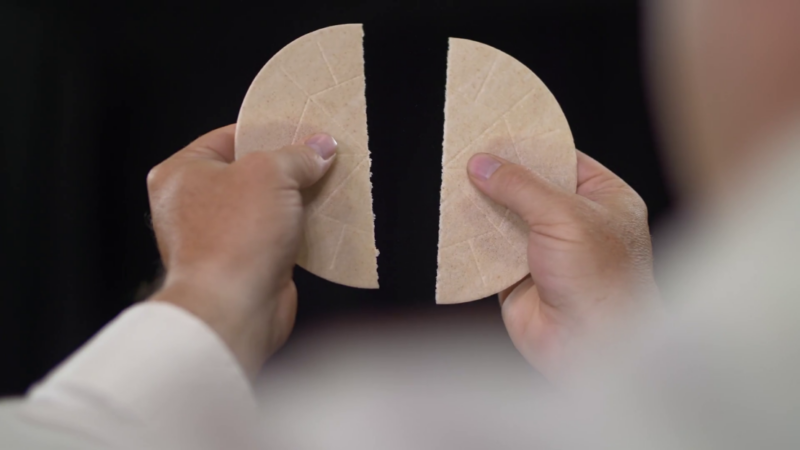
An important action during the Mass occurs when, before Communion, the priest breaks the consecrated host he is to consume in two pieces. This action is an essential part of the celebration of the Mass. From the very beginning, for the early Church, this action meant the celebration of the Eucharist itself, so much so that in the Acts of the Apostles we find a number of references to Christians that gather on the first day of the week—Sunday—to celebrate the day of the Lord’s Resurrection—to break the bread (Acts 2:42. 46; 20:7. 11; see also 1 Cor 10:16). The meaning of this action is easy to understand because it is the same action that Jesus enacted at the Last Supper which is also repeated at every Mass in accordance with his command: “do this in remembrance of me” (Lk 22:19; 1 Cor 11:23-25).

In a previous article we had already explained why the priest places a piece of the host in the chalice (see Why does the priest break a piece of the Host and place it in the Chalice?). At that moment we are also struck by the fact that, while we pray the Lamb of God, the priest does not pray with the congregation … what is taking place at that time?

At that time the priest is praying one of the few prayers which he silently prays on his own. It is also one of the few prayers during the Mass which is addressed to Jesus—most of the prayers are addressed to the Father through Jesus. The reason the priest prays this prayer alone is an expression of the intimacy between the Eucharist and the priesthood: The celibate priest in the Roman Rite, before receiving the Eucharist, prays to the love of his life. He prays that he may be purified from his sins as well as strengthened in his fidelity to Christ.

The Roman Missal offers two prayers for the priest to choose from:

Lord Jesus Christ, Son of the living God,
who by the will of the Father
and the work of the Holy Spirit,
through your Death gave life to the world;
free me by this, your most holy Body and Blood,
from all my sins and from every evil;
keep me always faithful to your commandments,
and never let me be parted from you.

Or:

May the receiving of your Body and Blood,
Lord Jesus Christ,
not bring me to judgment and condemnation,
but through your loving mercy
be for me protection in mind and body,
and a healing remedy.

Now that you know what the priest prays at that time during the Mass, it would be a good idea to pray with the same intention and remember also to pray for the priest who is celebrating Mass. He also needs prayer!

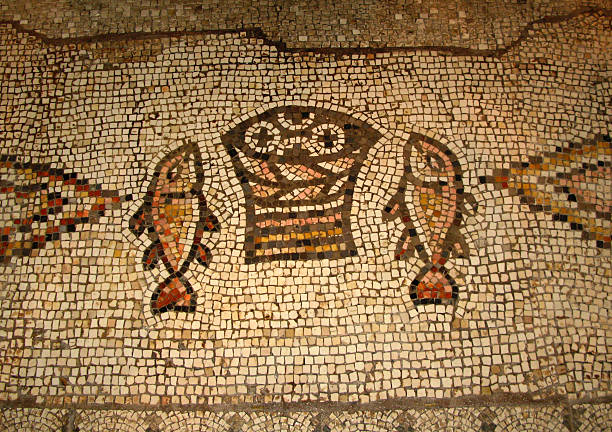
Why do we use the fish as a Christian symbol?

From ancient times, the fish has been associated with Christianity. The Greek word for fish is ichthys. From the beginning Christians made an acronym from it: Iesous Christos Theou Yios Soter, which means Jesus Christ, Son of God, Saviour. In Scripture we find a number of references to fish. For example, Jesus fed five thousand men with two fish and five loaves. He also called his disciples ‘fishers of men’. Tertullian uses the Ichthys symbol to compare Christians to fish, since they were born of water into Jesus Christ. In the Gospel according to St Matthew, Jesus says: “the kingdom of heaven is like a net that was thrown into the sea and caught fish of every kind” (Mt 13:47).

After his resurrection from the dead, when Jesus appeared to his disciples on the shore of the sea of Galilee, we find Simon Peter on his boat bringing back to land a net containing one hundred and fifty-three large fish: “Simon Peter went aboard and hauled the net ashore, full of large fish, a hundred fifty-three of them; and though there were so many, the net was not torn” (Jn 21:11). Why does the evangelist specify that there were one hundred and fifty-three fish caught in the net? St Jerome in the fourth century writes that this number symbolises all species of fish, and therefore signifies that there is a place for everyone in the Church. It is also interesting to note that if we were to count the number of times Jesus blessed various individuals in the four Gospels, it would amount to one hundred and fifty-three people, on forty-eight different occasions.

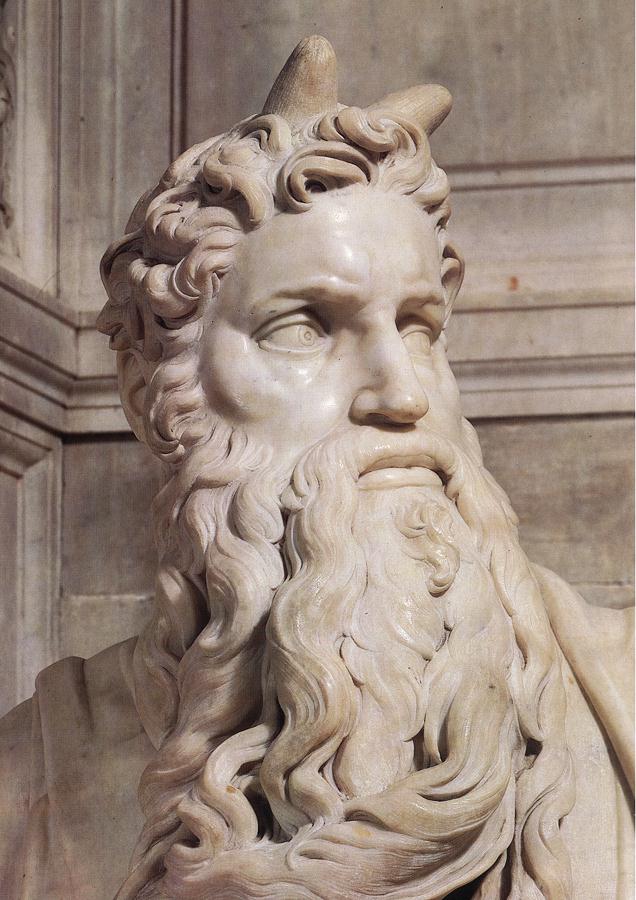
Why is Moses portrayed with horns on his head?

What happened to Moses when he encountered God? Did his face shine or did he grow horns? When we look at Moses’ iconography, he is frequently portrayed as having horns on his head. According to what was written in the Bible, when Moses came down from Mount Sinai, his face changed. This is what is written in the Book of Exodus:

Moses came down from Mount Sinai. As he came down from the mountain with the two tablets of the covenant in his hand, Moses did not know that the skin of his face shone because he had been talking with God.

Exodus 34:29

In Hebrew the verb to shine is קרנ (q-r-n). The account in Exodus 19 describes the events at Mount Sinai. When the Jewish people arrive, God tells Moses: “If you obey my voice and keep my covenant, you shall be my treasured possession out of all the peoples” (Ex 19:5), and God offers to make a covenant with the people. Moses’ face begins to shine when he encounters God, but Moses does not realise it; it is the people who see his shining countenance. This verb caused numerous arguments to arise throughout history, because the noun ‘qeren’ means ‘horn’. Some of the principal reasons that this word is translated as ‘shining’ and not a ‘horn’ are as follows:

  1. The subject of the verb ‘q-r-n’ is the face, not the head. It is unlikely that horns grew on Moses’ face without him noticing.
  2. The horn as a symbol does not make sense in light of what Moses had experienced.
  3. The majority of the principal Biblical translations, apart from the Vulgate, translate this verb as ‘shining.’

Since the Vulgate (the Bible translated from the original languages into Latin by St Jerome) was the translation used for many years, Michelangelo created his sculpture of Moses based on the Vulgate’s translation:

Cumque descenderet Moyses de monte Sinai, tenebat duas tabulas testimonii, et ignorabat quod cornuta esset facies sua ex consortio sermonis Domini.

And when Moses came down from the mount Sinai, he held the two tables of the testimony, and he knew not that his face was horned from the conversation of the Lord.

Ex 34:29 (Douay-Rheims 1899 American Edition)

This is the reason why Michelangelo sculpted Moses with horns on his head. Throughout history, these horns have been interpreted as symbols of wisdom and leadership.

When the water is so warm you’re ready to spit it out …

Because I got sick and tired of travelling back and forth with plastic bottles, I decided to make a more sustainable choice for the environment by purchasing a water filter jug. If nothing else, I have saved myself from having to buy and carry packs of water from the store to the car, and then from the car to my apartment, which is located on the second floor in a building with no elevator!

But, while this was a great solution during the winter months, it is not always ideal in summer. Although the water is not so hot as to be good to make a cup of coffee or tea, sometimes I end up filling the jug with warm water because the water supply pipes are exposed to the heat …

Doesn’t this remind you of two verses from the Book of Revelation?

“I know your works: you are neither cold nor hot. Would that you were cold or hot! So, because you are lukewarm, and neither cold nor hot, I will spew you out of my mouth.”

Rev 3:15-16

It’s true, that’s what you would feel like doing. It’s similar to when you’re thirsty and you have to drink from a bottle that was in a car parked in the sun!
But this verse is not simply imagery or a metaphor, because it describes a real situation in the city of Laodicea at that time. Although very rich—so much so that, when the city was destroyed by an earthquake, it was in such a strong financial position that it refused imperial assistance—the city lacked a natural source of water. Thus water had to be brought from somewhere else. And it was brought from such a long distance away that it became lukewarm and almost unpleasant to drink. This greatly contrasted with the thermal springs that were found in the city of Hierapolis, which, through their warmth, had curative properties, or the flowing pure springs of the city of Colossae that revitalised all who used them.

Therefore, the word of Christ, the “Amen, the faithful and true witness, the origin of God’s creation” (Rev 3:14), becomes more potent. If our words, attitudes, attentiveness, and compassion in our parish community and towards our neighbour do not bring the soothing relief of warm water, nor quench the thirst of those who are living an aimless life, we will be spat out because we would be living a mediocre Christian life—a life in which we may do nothing wrong but neither do we accomplish the good we should do …

Today Laodicea no longer has this problem because it was destroyed and abandoned in the thirteenth century, and I can be a bit more practical by placing a jug of water in the fridge. But our struggle not to become lukewarm is always present and cannot be resolved unless we give heed to the final proposition that Jesus gives to the Christians of Laodicea and to us also:

“Listen! I am standing at the door, knocking; if you hear my voice and open the door, I will come in to you and eat with you, and you with me.”

Rev. 3: 20

The Imnarja Races

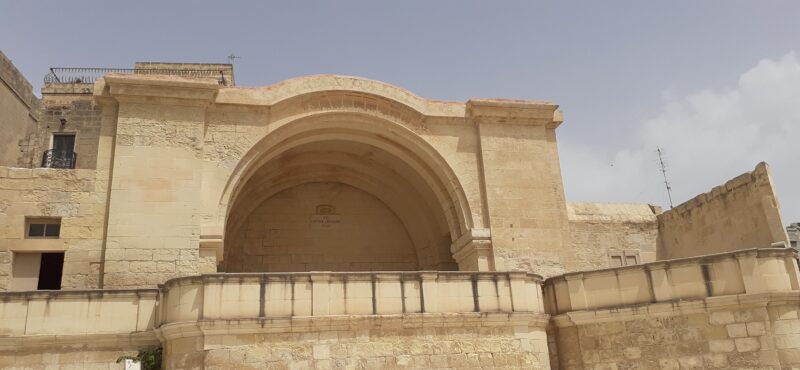
One very old tradition, which is still observed today, is the races held as part of the Imnarja celebrations on the feast of the Apostles Peter and Paul. These races were common in many of the local feast. These days, there are only horse races, but in the past, races were also held with donkeys, as well as races for children, men, and slaves. It seems that these races, which take place in the afternoon on the road that from is-Saqqajja (Rabat) leads to Siġġiewi—Triq it-Tiġrija, in English Racecourse Road—have always been of great importance to the public. The eighteenth-century historian Canon Aguis de Soldanis attests to this, when criticising the people for spending long hours in the sun when compared to the lack of patience they exhibited during liturgical celebrations. It is amazing how certain customs and attitudes haven’t changed much throughout the centuries!

At the end of the race, the Grandmaster would present flags—palijiet in Maltese—as prizes to the winners. Originally, these awards were distributed from a wooden pavilion at the end of Triq it-Tiġrija. Towards the last quarter of the seventeenth century, plans were drawn up to build a permanent structure. This pavilion was designed by Lorenzo Gafa and was completed in 1696.

Apart from this date, on its wall we also find an inscription in Latin which says: CUI LEGITIME CERTAVIT, referring to a verse from St Paul’s Second Letter to Timothy which states: “In a similar vein, no athlete can receive the winner’s crown unless he has competed according to the rules” (2 Tm 2:5). This is not the only time St Paul uses metaphors relating to athletic competitions to describe the Christian life. In the Letter to the Philippians, the end of the race is associated with the final goal of the Christian life: our final union with Christ (Phil 3:14). This is why he insists with the Corinthians that, if athletes strive for a prize that fades away, how much more should we struggle for that which we know cannot be taken from us and is never-ending (1 Cor 9:24-27).

May we also, in our race of life, not toil for things that do not last, but like St Paul live serenely, knowing that in all that we do we are fighting the good fight, running to finish the race, and keep the faith to the end (2 Tim 4:7).

Why is St Cecilia the Patron Saint of Musicians?

On 22 November the Church celebrates the memorial of St Cecilia, virgin and martyr. Christian tradition regards her as the patron saint of musicians, so much so that there are many activities of a musical nature held on her feast day, and a number of choirs named after her. But why is she associated with music?

St Cecilia lived around the third century and her cult was so widespread in Rome that her name was inserted in the Roman Canon—which is the First Eucharistic Prayer. In the account of her martyrdom, St Cecilia is praised for her great example of Christian womanhood in guarding her virginity and suffering martyrdom for the love of Christ.

According to early sources, it appears that Cecilia came from a noble family and had made a vow of virginity to God, but her parents gave her into marriage to Valerian, a pagan youth also from a noble family. It is said that, when they went to their living quarters after the wedding, Cecilia told Valerian that an angel was with her jealously guarding her purity. Valerian wanted proof of this, so she sent him along the Via Appia to meet with Pope Urban to baptise him. Valerian did as he was told and upon his return he saw the Angel beside her. It is said that this event prompted Valerian’s brother, Tiburtius, to be baptised, and together they began to evangelise and bury those Christians who had suffered martyrdom.

St Cecilia’s connection to music is probably based on an erroneous tradition in one of the accounts on her life that says: cantantibus organis illa in corde suo soli domino decantabat. Although the correct translation for this phrase is that, at the wedding feast, while the musicians played, Cecilia sang in her heart to her Lord alone. Most probably, the phrase ‘Cantantibus organis’ was misinterpreted to mean that Cecilia herself was playing the organ. It is for this reason that, in her iconographic representations from the fourteenth and fifteenth centuries, St Cecilia is often depicted as playing an organ.

Moving on from this anecdote, it would be appropriate to remember with gratitude those who are responsible for music and singing during the liturgy—many of whom are volunteers—and to pray for them in order that, through their ministry, they may truly raise the hearts of the congregation to the Lord.

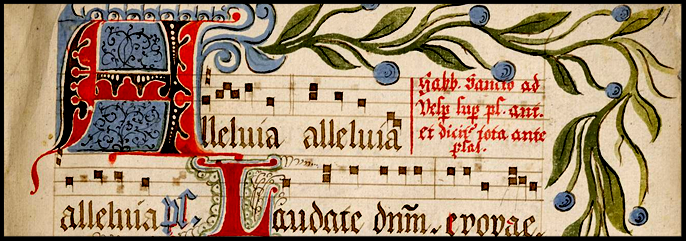
What does “Alleluia” mean?

If there is one word that every Christian in the world knows, no matter what rite or denomination they may belong to, is undoubtedly ‘Alleluia’. The origin of this Hebrew word is a combination of a verb and a noun. The verb is hillel which means praise—a verb which is used many times in the Hebrew Bible. This verb can also mean boasting. The noun jah is a concise form of God’s name. Therefore, the word Alleluia means “Praise God.”

The last five Psalms in the Book of Psalms are in praise of God in which ‘Alleluia’ is frequently used. Psalm 148 begins with, “Alleluia. Praise the LORD from the heavens; offer praise to him in the heights!” (v. 1), it concludes with the words, “He has raised high a horn for his people,
to the glory of all his saints, for the people of Israel who are close to him. Alleluia” (v. 14). The call to praise God is not addressed to God, but to all creation which is invited to praise God.

In the Roman Rite, the word Alleluia is associated with joy. Before the reading of the Gospel, the congregation sings Alleluia, in order that “the assembly of the faithful welcomes and greets the Lord who is about to speak to it in the Gospel” (General Instruction of the Roman Missal, par.62)

Skeletons and Corpses in our Churches?!

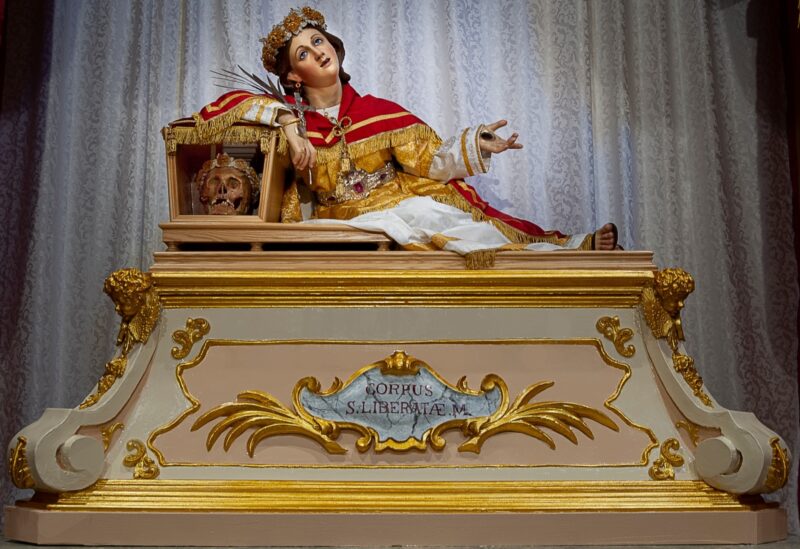
While the cranium is chosen and favoured over the rest of the remains of the relics of a saint, complete skeletal remains were once obtained for the veneration of the faithful. Under several altars in our churches, we find preserved bones of numerous saints whom, although their names have been lost through the passage of time, we know that they existed in an environment in which they would have lived a life worthy of being raised to the honour of the altar, as well as meriting them the veneration of the faithful. In Scripture we find examples that help us understand the value of the bodies of those who cooperated with the salvific plan of God. In the Second Book of Kings, we read that a gang of robbers came upon a group of men who were burying a man. Out of fear these men threw the body in the tomb of the Prophet Elisha. When the man’s body came in contact with the bones of Elisha he came back to life (2 Kings 13:21).

The same did not happen when the protestants in northern Europe destroyed the relics of the saint that the Church had under her care. However, these churches did not stay without relics for long. When the Catacombs of ‘dei Giordani’ where discovered at Via Salaria in Parioli in 1578, various translations of relics of saints from Rome began anew to northern European countries ensuring that the Christians who inhabit that part of Europe would not be deprived of holy relics.

Locally, this practice had nothing to do with this. In Malta, this custom became more common between the 17th and 18th centuries. We find that in these two centuries no less than 24 relics of the saints were brought to Malta. For example, we find that the Inquisitor Ruffo sought permission from the Pope to obtain the relics of St Beninus for Vittoriosa, as well as the relics of St Victor for the Parish of Naxxar from the Inquisitor Giovanni Mancinforte.

The arrival of a saint’s relics meant grand celebrations: vigils and processions, fireworks and orchestral performances. The veneration of these relics was so strong that not only were earrings, rings and necklaces donated as in the case of St Consolata of the Discalced Carmelites in Cospicua, but in certain villages, children were also given the names of these saints at Baptism. We find for example that even in recent times in Ħaż-Żabbar the name of Felix and other derived names of St Felicianus, who’s relics are found in this locality, were given to children in his honour. In this particular case, a confraternity was also established in honour of St Felicianus with the aim of undertaking charitable initiatives.