



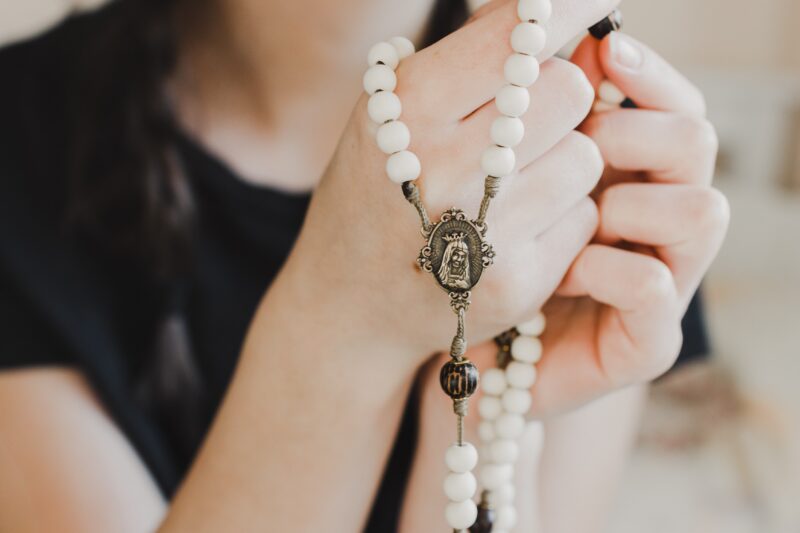
The month of October reminds us of the Church’s precious prayer to Our Lady: the Rosary. This prayer has a very rich history. According to tradition, in the thirteenth century Mary herself appeared to Saint Dominic and gave him the Rosary, expressing her desire that Christians should pray it. Over the centuries, this prayer has undergone various changes and additions, yet one thing remains true: the Rosary has accompanied countless Christians throughout the years as they have reflected upon the mystery of God’s love for us. But what meaning does this prayer have for Christians today?
In 1974, Pope Paul VI wrote an Apostolic Exhortation on Our Lady entitled Marialis Cultus (Devotion to the Blessed Virgin Mary). This exhortation focuses on the proper ordering and development of devotion to the Blessed Virgin Mary and is divided into three sections, with the final section dealing specifically with the prayers of the Angelus and the Rosary.
Pope Paul VI emphasises that the Rosary is principally rooted in the Gospel, particularly in the mystery of the Incarnation, in which the Word of God chose to become human like us. Indeed, the Pope writes:
The Rosary draws from the Gospel the presentation of the mysteries and its main formulas. As it moves from the angel’s joyful greeting and the Virgin’s pious assent, the Rosary takes its inspiration from the Gospel to suggest the attitude with which the faithful should recite it. In the harmonious succession of Hail Mary’s the Rosary puts before us once more a fundamental mystery of the Gospel—the Incarnation of the Word, contemplated at the decisive moment of the Annunciation to Mary.
Marialis Cultus, par. 44
Here the Pope connects what the Christian prays in the Rosary with the way he or she lives. Before each decade of the Rosary, the Christian places before themselves the mystery of our redemption. This is not simply an exercise of the mind, but a choice to allow this mystery to become a reality in one’s own life.
Indeed, the Pope draws attention to the danger of praying the Rosary too quickly or mechanically, so that the person praying may scarcely be aware of what they are saying or of the mystery they are contemplating. On the contrary, Christians should recognise how, through meditating on the mysteries of the Rosary, they unite themselves with Mary in the mystery of our redemption.
Towards the end of the exhortation, Pope Paul VI also highlights the connection between the Rosary and the liturgy. He explains that the Rosary can be an excellent preparation not only for becoming familiar with the mysteries of Christ, but also for celebrating those mysteries together with the community in the liturgy.
When I pray the Rosary, how do I pray it? Do I know how to pray it slowly and attentively?
Which mystery that we contemplate in the Rosary feels particularly important for my life at this moment, and why?